
Table of Contents
If you are searching for how to find a therapist in Calgary, then it shouldn’t feel opaque. Beyond location and availability, the real differentiators are clarity of approach, how sessions are structured, and how quickly you’ll know what the plan is. Here are the questions most people don’t realize they can (and should) ask, before you book.
Therapist, psychologist, counsellor: what is the difference in Alberta?
The titles blur together, but in Alberta they are not interchangeable.
- Psychologist is a protected, regulated title. Psychologists are registered with the College of Alberta Psychologists (CAP). A Registered Psychologist has completed full registration; a Provisional Psychologist has finished the required education and is completing supervised practice hours toward full registration.
- Social worker, including clinical social workers who provide therapy, is a protected title regulated by the Alberta College of Social Workers (ACSW).
- Counsellor and therapist are broader terms. Some counsellors hold the Canadian Certified Counsellor (CCC) designation through the Canadian Counselling and Psychotherapy Association.
You do not need a doctor’s referral to start with a psychologist, social worker, or counsellor in Alberta. What matters most is that your provider is registered with their regulatory college and works in a structured, accountable way.
How to Choose a Therapist in Calgary (Step-by-Step)
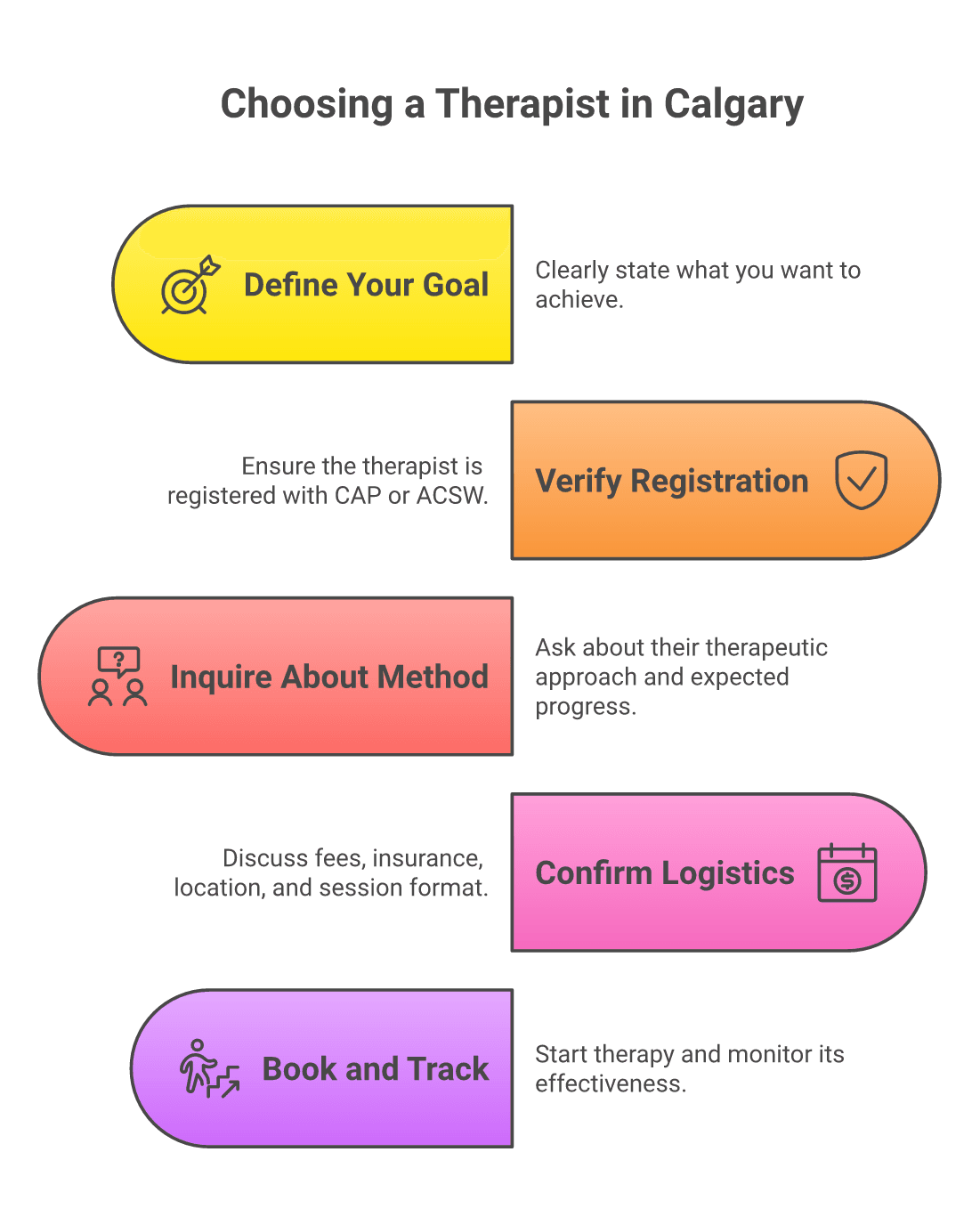
Finding a therapist in Calgary doesn’t need to be guesswork. Here’s a clear, five-step process to narrow your options and feel confident before booking.
- Clarify what you want help with. Start by identifying the main challenges or goals you’d like therapy to address, for example, stress, anxiety, boundaries, or unhelpful patterns that keep resurfacing.
- Check credentials and registration. In Alberta, both Registered Psychologists and Registered Social Workers can provide therapy. Verify registration through the College of Alberta Psychologists or the Alberta College of Social Workers.
- Compare structure and approach. Ask how sessions are organized and how progress is tracked. Some models focus on open-ended discussion; others, like ShiftGrit’s Identity Pattern Therapy, follow a defined roadmap that includes intake, belief-mapping, and reconditioning work.
- Review logistics and coverage. Standard therapy fees in Calgary range from $200–$235 per 50-minute session (per the Psychologists’ Association of Alberta). Check your workplace or student plan to confirm coverage amounts and eligible credentials.
- Book a first session or consultation. A single intake session gives you insight into fit, communication style, and whether the process feels clear and structured. Trust that informed first impression, it usually tells you what you need to know.
How to Decide Which Calgary Therapist Is Right for You
🧭 Therapist Comparison: Calgary Options at a Glance
| Type | What It’s Best For | Average Cost | Wait Time | Availability |
|---|---|---|---|---|
| Registered Psychologist | Complex mental health concerns | $200–$235 | Low | Evenings, weekends |
| Counsellor / Social Worker | General emotional wellness | $150–$229 | Moderate | Limited weekends |
| ShiftGrit Identity-Level Therapy | Pattern reconditioning, anxiety, trauma | Varies by tier | Short | High availability |
Why “clicking” with your therapist matters less than you would think
Most advice on finding a therapist tells you to keep shopping until you find someone you click with. It is reasonable advice. It is also incomplete.
Here is what the research shows about what moves the needle.
The connection tends to follow the progress, not cause it. In one study of structured therapy for depression, the largest improvements were set up by the work done in session, and clients’ sense of connection strengthened after those gains, not before (Tang and DeRubeis, 1999).
Therapists often cannot tell when therapy is stalling. Across the research, 5 to 14 percent of clients get worse during treatment, and clinicians frequently miss it. Systematically tracking progress can roughly halve that deterioration (Lambert and Shimokawa, 2011).
Measuring progress changes outcomes. A meta-analysis of 24 studies found that routinely measuring a client’s progress, and feeding it back into the work, nearly doubled meaningful improvement among clients who were otherwise headed for a poor outcome (Lambert, Whipple and Kleinstäuber, 2018).
The individual therapist explains less than you would expect. Across six clinical trials and 4,549 clients, the specific therapist accounted for only a small share of how people did, and adding progress feedback narrowed the gap between more and less effective therapists by roughly 18 percent (Delgadillo et al., 2022). Years of experience alone do not reliably make a therapist more effective; in one Calgary agency, what improved results over seven years was systematic measurement and structured practice (Goldberg et al., 2016).
What does carry weight is the method, delivered well. How competently and faithfully a treatment is delivered is linked to outcomes to a degree comparable with the relationship factors therapists usually emphasize (Power et al., 2022). And in structured therapies, how much and how well clients do the work between sessions is associated with better results (Kazantzis et al., 2016).
Think of it the way you would think about surgery. You do not need to feel a personal bond with your surgeon. You need a competent one following a procedure that works. Researchers describe a “surgeon effect” on outcomes that mirrors the known “therapist effect,” where results vary by practitioner in ways their experience alone does not explain (Schnelle et al., 2022).
None of this means the relationship does not matter. It means the relationship is not the thing to screen hardest for.
This is why ShiftGrit runs a structured, goal-oriented program with progress measurement built in. When the method does the heavy lifting and your progress is tracked session by session, you are choosing a defined process, not gambling on chemistry.
Red flags when choosing a therapist
A few signs are worth taking seriously:
- They will not clearly explain their approach or what progress should look like.
- There is no way to tell whether therapy is working. Good practice includes some form of progress tracking.
- They talk more about themselves than about your goals, or cannot accept questions and feedback.
- They are vague about their registration or credentials.
- They promise a guaranteed cure or a fixed timeline. Responsible, regulated providers do not guarantee outcomes.
Most of these come back to the same thing: a lack of structure and accountability.
Fees, insurance, and receipts in Calgary
Therapy is an investment, and in Alberta, the numbers are standardized. The Psychologists’ Association of Alberta (PAA) recommends $235 for a 50-minute session (effective January 1, 2025). That’s the rate insurance companies are built around.
At ShiftGrit Calgary, fees vary by provider tier (see how our pricing works below). Every eligible session comes with receipts ready for insurance. No games. No hidden add-ons. Just transparent, regulated pricing.
Think of it like the gym: you can dabble forever with random workouts, or you can follow a structured program built around a clear plan.
How ShiftGrit pricing works
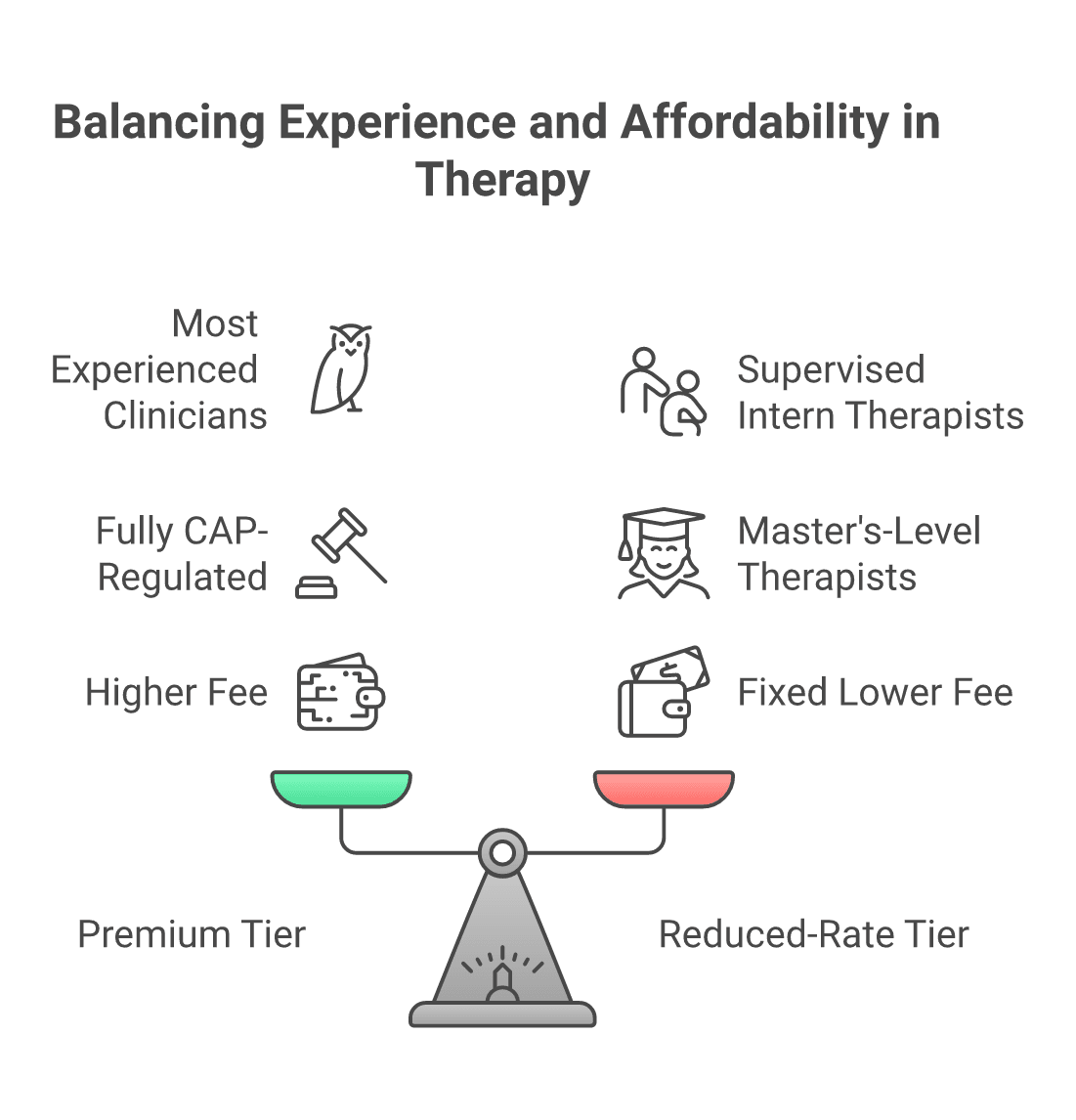
Every tier delivers the same structured method. What changes is the clinician’s training, experience, and level of supervision, and the fee.
- Premium: our most experienced clinicians, fully regulated by the College of Alberta Psychologists.
- Standard: licensed or provisionally licensed clinicians delivering the same structured, evidence-based therapy.
- Reduced-Rate: master’s-level therapists and supervised intern therapists at a fixed lower fee, to keep access open. Intern Therapist sessions are not eligible for insurance reimbursement.
You will see the exact fee for each provider when you book, and every eligible session comes with a receipt for insurance.
Free and lower-cost mental health support in Calgary
Private therapy is not the only route. A few options worth knowing:
- Access Mental Health (Alberta Health Services) connects you to publicly funded services.
- Alberta Mental Health Helpline: 1-877-303-2642, available 24/7.
- 211 Alberta: dial 2-1-1 for community and social services.
- Distress Centre Calgary: 24-hour crisis and counselling support.
- Community and training clinics offer sliding-scale or reduced-fee counselling.
If you are in crisis or thinking about suicide, call or text 988, the Suicide Crisis Helpline, available across Canada.
In-person vs virtual in Calgary: what’s better for you?
- In-person (17th Ave SW, Mount Royal): private offices, easy access, accessible underground parking. Great if you want the full immersive experience.
- Virtual: same structured therapy, but from your kitchen table or home office. Calgary clients love this during winter or between meetings.
Our data shows virtual works just as well. The choice is lifestyle.
When to switch therapists (and how to do it gracefully)
Here’s the usual advice: “If you don’t click, switch.” That’s not wrong, but it’s incomplete.
In traditional therapy, “fit” matters a lot because you’re leaning on the relationship over the structure. If you and your therapist don’t vibe, progress stalls.
With Identity Pattern Therapy, the fit still matters, but less. The process itself carries you. It’s structured like a program, not a coffee chat. That means:
- If you switch therapists at ShiftGrit, you don’t lose momentum. The plan, the inventory of beliefs, the session structure, it transfers seamlessly.
- You don’t restart from zero. You pick up where you left off.
So yes, give it three sessions. But don’t overthink “fit.” Think “structure.”
How You’ll Know Therapy Is Working
We explore these shifts in more detail throughout our Calgary therapy guides. Progress in therapy doesn’t always look like fireworks, it often shows up in the quieter moments when you notice that you’re responding differently.
Here’s what clients commonly report as signs of traction:
- You pause before reacting and feel more choice in what comes next.
- Thoughts of “I should” or “I can’t” start to shift into “I could.”
- The emotional “hangover” after stressful events shortens.
- Triggers feel informative instead of overwhelming.
These are signals that your threat system is recalibrating and your cognitive mind is back in the driver’s seat.
That’s how Identity-Level Therapy and Reconditioning translate into real-life change.
Andrea McTague and Brendon Braithwaite walk through the same question from the clinician’s side in Episode 39 of The Shift Show: what a real game plan looks like, how quickly the needle should move, and the questions a competent therapist should be able to answer before you commit. The full conversation and transcript are on the episode page.
Calgary neighbourhood notes (17th Ave / Mount Royal) & parking
We get it, logistics matter. Our Calgary office is at 17th Ave SW and Mount Royal. Central, accessible, and not the nightmare parking situation you expect downtown.
- Accessible underground or street parking options
- Coffee shops around the corner
- Evening and weekend availability
If you’re commuting from the suburbs, virtual saves you time. If you’re in the Beltline or downtown, the office is a quick hop.
How to book (and what to prepare)
- Step 1: Check availability online → See Calgary availability.
- Step 2: Book a 50-minute intake.
- Step 3: Show up with an open mind. We’ll guide the rest.
You don’t need to know “where to start.” That’s our job.
Calgary’s achievement culture, boom-and-bust economy, and high-pressure professional environment activate deeper identity-level patterns faster than most people realize. That’s why our approach starts at the identity layer, not just surface symptoms.
Identity-Level Therapy in Calgary
Identity-Level Therapy targets the belief patterns and emotional loops driving automatic reactions—not just the surface symptoms. By working at the identity layer, clients shift how they interpret safety, regulate threat, and relate to themselves and others. The result: reconditioning at the root of shame, self-sabotage, reactivity, and overwhelm.
It’s organized around three pillars:

ShiftGrit Core Method™
Our structured framework for breaking outdated identity patterns.
Learn More
The Pattern Library
Real-world examples of loops like perfectionism, procrastination, and shutdown.
Learn More
The Glossary
Clear definitions that keep the language sharp and the process transparent.
Learn More👉 Browse Calgary Therapy Guides
“What’s your approach, and when do I feel progress?”
Most people never ask this. They assume therapy = talking until you eventually “feel better.” The problem? Talking is not the same as progress.
If you’re interviewing a Calgary therapist, ask: “What’s your process? How do I know it’s working in three sessions?”
With traditional, meandering talk therapy, you might walk out of Session 1 feeling… not much. Maybe you shared your story, maybe you cried. But where’s the plan?
ShiftGrit does it differently. We run Identity Pattern Therapy to deliver the ShiftGrit Core Method™, a structured, results-driven approach. The entire thing is engineered for clarity, direction, and actual change. It’s not “show up and chat about your week.” It’s structured counselling designed to recondition your brain.
✅ Summary:
Finding a therapist in Calgary isn’t about choosing a location or a price, it’s about finding a structured, results-based method that helps you recondition the root of your patterns.
Here’s what directed, structured, results-driven therapy looks like
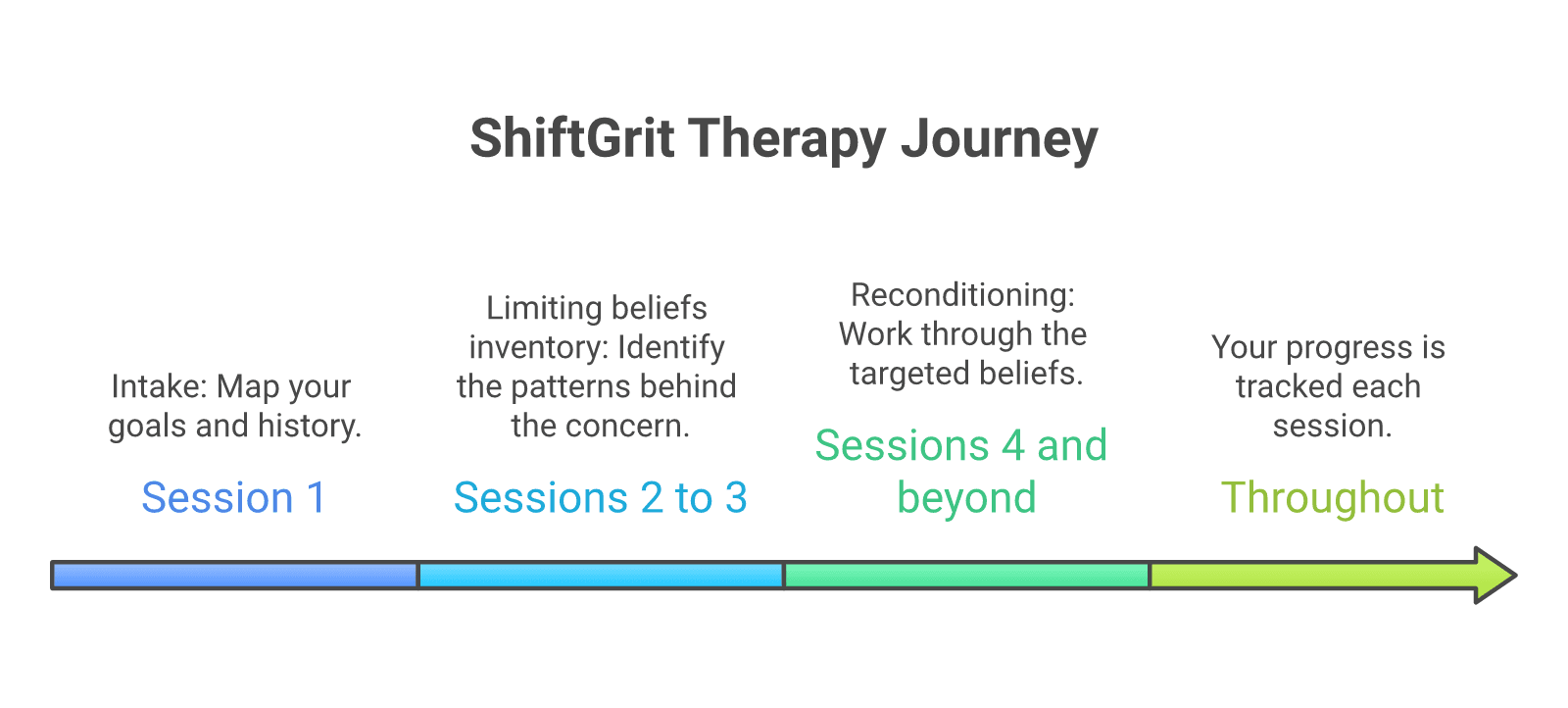
Session 1 – The Intake
50 minutes, deep dive. We’ll ask about everything, sleep, childhood, current triggers. The goal: identify your global limiting beliefs (like “I am not good enough” or “I Am Defective”) and build a plan.
Sessions 2–3 – Limiting Beliefs Inventory
We map the beliefs and create an inventory of the patterns driving the concern. You’ll see how the puzzle fits together.
Sessions 4 and beyond – Reconditioning
We use evidence-based techniques to rewire how your “walnut brain” (the primitive survival brain) reacts to memories and triggers. It’s like erasing the emotional charge from old wounds. The memory stays, but the sting is gone.
This is goal-oriented and measurable. You know what’s happening and why it matters at each step.
Transparent plan: session structure & pacing
Here’s the Calgary therapy market reality: most clinics don’t publish their process. It’s vague, it’s “supportive,” it’s… whatever. That’s comforting, but not helpful when you’re investing time and money.
At ShiftGrit, you don’t wonder if anything’s happening. You see the map. You know what each phase is for and what happens in Session 1, 2, 3 & 4. That clarity is priceless, and rare.
Book with a registered therapist or psychologist in Calgary
Meet a few of our clinicians and learn what to expect in your first session.
Browse profiles, watch intro videos, and book online when you’re ready.













See all Calgary therapists & book your first session →
Explore Calgary therapy by concern
Once you know what you want to work on, these Calgary guides go deeper:
- Anxiety therapy in Calgary
- Depression therapy in Calgary
- ADHD therapy in Calgary
- Trauma therapy in Calgary
- OCD therapy in Calgary
- PTSD therapy in Calgary
- Self-esteem therapy in Calgary
Wondering who is the right fit? See how to judge the best therapist in Calgary for you, learn about Identity-Level Therapy, or read our guide to finding a therapist in Edmonton.
Do I need a doctor’s referral to start therapy?
What’s the difference between Provisional and Registered Psychologists?
Are my sessions confidential—even with insurance?
Should I choose in-person or virtual sessions?
How will I know if therapy is helping?
What if I don’t feel like I’m clicking with my therapist?
What should I prepare for my first session?
Are there publicly funded or community resources in Calgary?
How much does therapy cost in Calgary?
What are red flags when choosing a therapist?
Is there a 'best' therapist in Calgary?
ShiftGrit Psychology & Counselling is included in the Calgary Chamber Toolkit Resources for Mental Health, serving the Calgary Zone through Identity-Level Therapy and Pattern Reconditioning.
Featured by the Calgary Chamber
The Calgary Chamber recently highlighted ShiftGrit’s approach to breaking the anxiety loop for high-performing professionals in Calgary.
Read the full Chamber article →
Shift Show Episode, Mind Over Money
If you’d like a deeper look at the belief patterns behind financial anxiety, listen to the Shift Show episode:
🎙️ Mind Over Money (Podcast Episode)
References & Community Resources
We believe in transparent, evidence-informed care.
Below are open-access resources that complement the work we do in session:
- MyHealth Alberta: Tips for Finding a Counsellor or Therapist
- Alberta Health Services – Help in Tough Times: Addiction & Mental Health Supports
- BounceBack Alberta: Free guided self-help program for people 15 + experiencing mild to moderate anxiety or depression.
- Tang T. Z., DeRubeis R. J. (1999). Sudden gains and critical sessions in cognitive-behavioral therapy for depression. J. Consult. Clin. Psychol., 67, 894-904. DOI
- Lambert M. J., Shimokawa K. (2011). Collecting client feedback. Psychotherapy, 48, 72-79. DOI
- Lambert M. J., Whipple J. L., Kleinstäuber M. (2018). Collecting and delivering progress feedback: a meta-analysis of routine outcome monitoring. Psychotherapy, 55, 520-537. DOI
- Delgadillo J., et al. (2022). Progress feedback narrows the gap between more and less effective therapists. J. Consult. Clin. Psychol., 90, 559-567. DOI
- Power N., et al. (2022). Associations between treatment adherence-competence-integrity and adult psychotherapy outcomes. J. Consult. Clin. Psychol., 90, 427-445. DOI
- Goldberg S. B., et al. (2016). Creating a climate for therapist improvement. Psychotherapy, 53, 367-375. DOI
- Schnelle C., et al. (2022). Is there a surgeons’ effect on patients’ physical health, beyond the intervention? Ther. Clin. Risk Manag., 18, 467-490. DOI
- Kazantzis N., et al. (2016). Quantity and quality of homework compliance: a meta-analysis of relations with outcome in CBT. Behav. Ther., 47, 755-772. DOI
If you need immediate mental-health support in Alberta, dial 211 or visit Help in Tough Times.