
Quick anchor. Ontario regulates four distinct mental-health credentials, Psychologists, Registered Psychotherapists, Registered Social Workers, and Canadian Certified Counsellors, through three separate colleges. OHIP covers psychiatric care and the publicly-funded Ontario Structured Psychotherapy program for adults with depression and anxiety-related concerns, but does not cover private therapy. As of June 20, 2024, all psychotherapy fees in Canada are GST/HST-exempt under Bill C-59. The directory you eventually open shows you names, but everything that determines whether the work fits sits upstream of that list.
Table of Contents
The Question Nobody Asks
If you live in Toronto and you’re searching for a therapist, the first ten links you open will tell you the same thing. Filter by credential. Filter by specialty. Read the bios. Book a consult. See who feels right.
That’s directory advice, and it’s not wrong. But it skips the question that actually decides whether the therapy works.
The question is: what layer of you is producing the symptom you want to change?
Anxiety, low mood, anger, avoidance, performance breakdown, sleep that won’t settle, these are surface phenomena. They’re real, and you’re not imagining them. But they’re not the engine. Underneath the symptom sits a coping pattern: the strategy your nervous system has been running to manage the symptom, overworking, withdrawing, people-pleasing, perfectionism, hypervigilance, numbing. Underneath the pattern sits a Limiting Belief, a deeply held statement about who you are that the pattern is built to protect. I Am Not Good Enough. I Am Unwanted. I Am In Danger. And underneath the belief sits the identity structure the belief is defending, the version of “you” that the belief was originally trying to keep safe.
The therapist you book is going to work at one of those four layers. Most won’t tell you which. The directory definitely won’t.
None of these is wrong. The wrong one is the one that doesn’t match the depth of work you actually need to do.
This guide is built for the moment before you open a directory. We’ll cover what the four therapist credentials in Ontario actually mean and what they cost. We’ll walk through the three real pathways from “I need help” to “I’m in therapy”, public, workplace, and private. We’ll lay out what your insurance is likely to cover, what the questions nobody asks before booking actually are, and where ShiftGrit’s approach fits if depth is what you’re after.
The directory comes at the end. Not the start.
Why Toronto Therapy Search Is Harder Than It Looks
Toronto is the largest mental-health services market in Canada. The Greater Toronto Area has thousands of regulated practitioners across four professional categories, three publicly-funded delivery models, dozens of insurance providers each with their own coverage rules, and a directory ecosystem that surfaces all of them in roughly the same way. The problem isn’t scarcity. It’s signal.
When every therapist’s profile reads “warm, non-judgmental, integrative approach,” when every clinic’s intake page promises “the right fit for you,” and when every directory surfaces the same five filters (city, credential, fee, specialty, language), the differences that actually matter become invisible. The directory does the easy work, sorting on attributes anyone can see, and leaves you with the hard work of guessing on attributes that are deliberately hidden behind generic language.
What the directory doesn’t tell you:
- Whether the credential you’re filtering for has the scope of practice you actually need (a Psychologist for formal assessment vs an RP for talk therapy is not a small distinction)
- Whether the practice runs an intake screening with admin staff, or a free fit call with the actual therapist (different first-step models, different signals)
- Whether your benefits provider covers that credential as a standard line item or only on certain plans (this varies more than the carrier’s marketing suggests)
- Whether the therapist’s modality reaches the layer you’re trying to work with, symptom relief, skill building, belief change, or identity-level shift
These are the structural decisions every Toronto resident has to make and that no directory does for you. The work of answering them, explicitly, before opening a directory, turns a paralyzing search into a filter you can actually use.
We wrote the same piece for Calgary when we noticed the same dynamic playing out there. Toronto’s version is denser, more practitioners, more credentials in active use, more insurance variation, but the diagnostic question is the same: the work you do before the directory determines whether the directory works for you.
What follows is that work, in the order it actually matters.
Decades of psychotherapy research show that the therapeutic alliance, the working bond between client and therapist, predicts outcome more reliably than the specific modality used (Horvath & Symonds, 1991; Norcross & Lambert, 2018). What our work adds is the question one layer up: alliance only delivers durable change when it’s targeting the layer where the pattern is actually generated.
Ontario Therapist Credentials at a Glance
Ontario has four professional categories that practise psychotherapy. They’re not interchangeable, and the difference between them affects what the session costs, what your benefits cover, and what kind of clinical work the credential is actually trained to do.
| Title | Regulator | Required training | Scope of practice | Typical Toronto fee | Insurance recognition |
|---|---|---|---|---|---|
| Registered Psychotherapist (RP) | College of Registered Psychotherapists of Ontario (CRPO) | Master’s-level training in psychotherapy + 1,000 supervised clinical hours + jurisprudence exam | Psychotherapy (talk therapy). Cannot diagnose, prescribe medication, or perform formal psychological testing. | $150–220/hr (avg ~$175) | Most major plans, universal since CRPO became a regulated profession |
| Psychologist (C.Psych.) | College of Psychologists and Behaviour Analysts of Ontario (CPBAO), renamed July 1, 2024 from CPO | Doctoral degree (PhD or PsyD) + supervised practice + EPPP exam + oral exam | Psychotherapy + formal diagnosis + psychological testing/assessment. Cannot prescribe medication. | $200–300/hr (avg ~$225); assessments $1,500–4,500 flat | Universal, every Canadian benefits plan covers psychologist sessions |
| Registered Social Worker (MSW/RSW) | Ontario College of Social Workers and Social Service Workers (OCSWSSW) | Master of Social Work (MSW) + registration + jurisprudence exam | Psychotherapy (under “controlled act” authorization). Can diagnose for treatment planning purposes. Cannot prescribe medication or do formal psychological testing. | $130–200/hr (avg ~$160) | Most major plans cover MSW/RSW; a small number restrict to “psychologist only” |
| Canadian Certified Counsellor (CCC) | Canadian Counselling and Psychotherapy Association (CCPA), national certification | Master’s in counselling/psychotherapy + supervised practice + ethics exam | Counselling/psychotherapy. Cannot diagnose, prescribe, or do formal testing. CCC is the standard pathway for cross-provincial virtual practice. | $130–180/hr (avg ~$150) | Variable. Sun Life: yes (added May 12, 2024). Manulife / Canada Life: plan-dependent. Green Shield: most plans cover. Always verify your specific plan. |
The four categories are regulated by four different bodies, train through four different pathways, and practise within four different scopes. Three of them, Registered Psychotherapist, Registered Social Worker, and Canadian Certified Counsellor, are positioned to do psychotherapy as their primary work. The fourth, Psychologist, can do all of that plus one thing the other three can’t: formal psychological assessment.
When You Actually Need to See a Psychologist
If you need an ADHD diagnostic assessment, an autism spectrum assessment, a learning disability evaluation, a custody or legal psychological report, or any document that needs a clinical psychological diagnosis on it, you need a Psychologist registered with the College of Psychologists and Behaviour Analysts of Ontario (renamed from the College of Psychologists of Ontario on July 1, 2024). No other Ontario credential can produce that documentation. This is one of the few places where credential matters more than fit.
For everything else, anxiety, depression, trauma processing, relationship work, addiction, identity-level work, the long-form depth therapy this guide spends most of its time on, the four credentials are roughly equivalent in delivery scope. They differ in training emphasis, fee point, and the theoretical model the practitioner brings, but all four are authorized to practise psychotherapy in Ontario.
How the Credentials Differ in the Insurance Ecosystem
Most Canadian extended-health benefits plans cover Psychologist sessions universally. RP coverage has been broadly adopted since the College of Registered Psychotherapists of Ontario finalized its regulatory framework. RSW/MSW coverage is similar, the Ontario College of Social Workers and Social Service Workers regulates the social-work side, and many Ontario practitioners holding an MSW also carry an Advanced Certificate in Psychotherapy. Canadian Certified Counsellor (CCC) coverage, issued through the Canadian Counselling and Psychotherapy Association, is plan-dependent and varies more than the others.
There’s a wrinkle worth knowing about: a number of clinicians practise virtually with Toronto clients while being primarily registered in another province (most commonly as an Alberta Registered Provisional Psychologist, paired with a CCC for cross-provincial practice). This is legal and clinically standard, the CCC credential is specifically designed to enable cross-Canada virtual practice, but it means your therapist’s regulatory body might be in a different province than yours. Your benefits coverage may treat them differently than a locally-registered RP.
A Practical Rule
If you don’t need formal assessment documentation, the credential matters less than the modality, the depth, and the fit. We come back to this in §12 with a decision flowchart that maps the credential question onto your actual situation. For now, the table above is the cleanest reference for who’s regulated by whom and what each credential typically charges.
Pathways to Therapy in Toronto
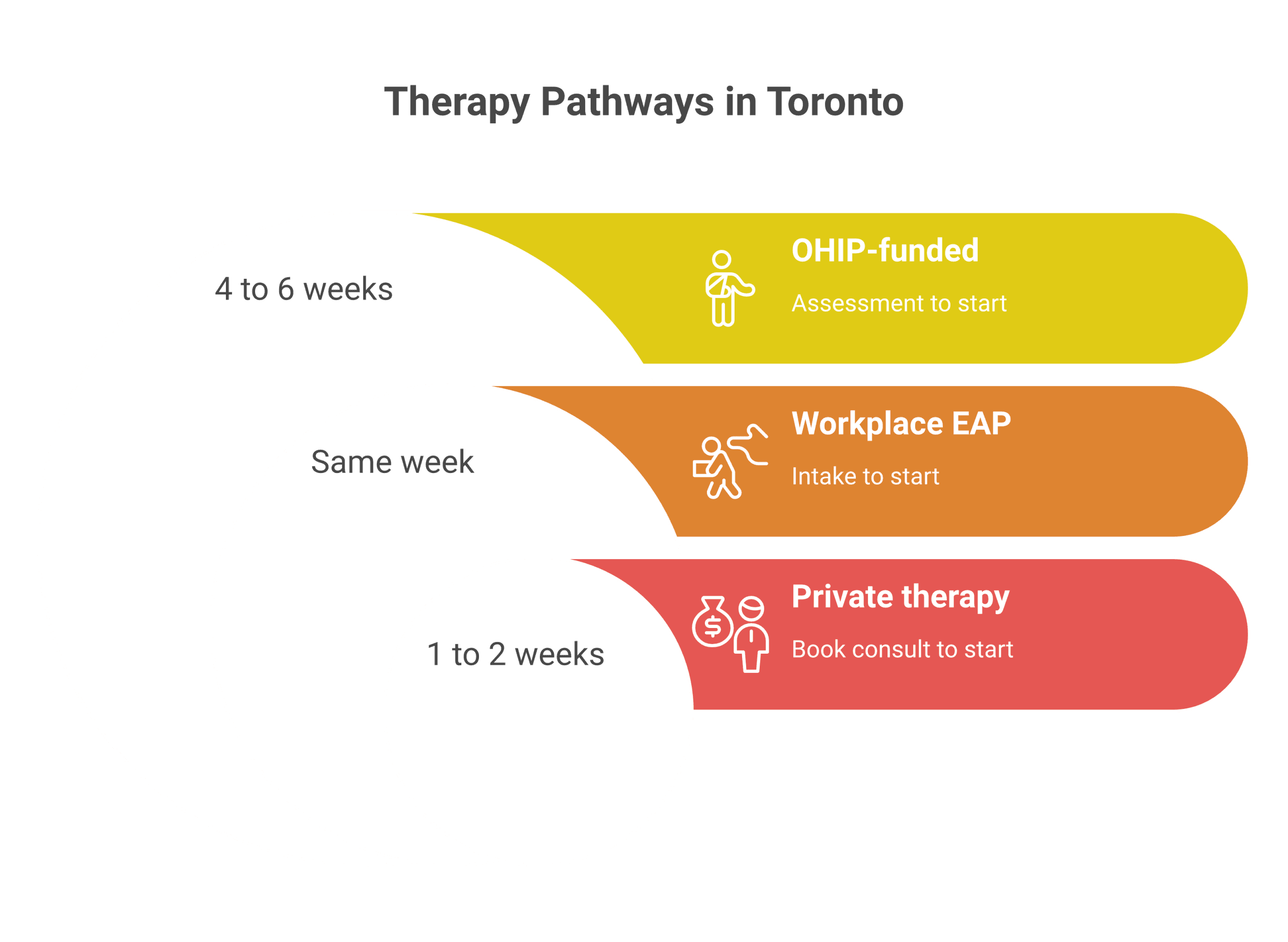
Three real routes get a Toronto resident from “I need help” to “I’m in therapy.” The differences are speed, cost, and provider choice, not quality. All three end at the same destination.
Route 1: The Publicly-Funded Route (Free, Slower)
The cheapest and the slowest. The most clinically meaningful entry point is Ontario Structured Psychotherapy (OSP), a province-wide program offering 8 to 20 sessions of CBT-based therapy for mild-to-moderate depression, anxiety, and PTSD, free at the point of service. Most clients reach OSP by self-referral or family doctor referral, then go through an assessment that determines program fit. Wait time from assessment to program start runs about 4 to 6 weeks in Toronto, per CAMH’s delivery partners (CAMH itself doesn’t publish a current Toronto-specific wait figure).
Other OHIP-funded options include direct hospital outpatient mental-health programs, family doctor referrals to psychiatry (for medication management or formal psychiatric care), and the CAMH Access Centre at 416-535-8501, option 2 for Access (for OSP specifically, extension 36777). The CAMH Access route is triage and referral, not direct therapy, and it routes you to community programs based on need.
The publicly-funded route is the right answer if your symptoms are mild-to-moderate, your timeline isn’t urgent, and free-at-point-of-service is decisive. It’s not the right answer if you need continuity beyond 20 sessions, if your situation is complex, or if you can’t wait the 4-to-6-week onboarding.
Route 2: The Workplace EAP Route (Free, Fast, Capped)
Fast and free but session-capped. Most Canadian employers with mental-health benefits include an Employee Assistance Program, typically 3 to 6 free sessions per issue per year, available within the same week of contact, confidential by design. Your manager doesn’t see your usage; HR sees aggregate utilization without names.
The EAP route is structurally a bridge, it covers the immediate need while you assess whether to extend the work privately. For situations that resolve in a handful of sessions (an acute work stress episode, a discrete relationship rupture, a grief navigation), EAP alone can be sufficient. For deeper or longer work, EAP runs out and the question becomes how to continue. Most clients combine EAP with extended health benefits and out-of-pocket private fees from there.
Route 3: The Private Route (Paid, Fastest, Most Flexible)
The fastest and most flexible. You search a directory, book a consultation, and start sessions, typically within a week. Fees range from $130 to $300 per session depending on credential, with extended-benefits plans typically reimbursing $80–$150 per visit up to an annual cap of $500–$2,500. The private route is the only one that gives you full control over therapist choice, modality, scheduling, and continuity.
If you want the fastest path with broad provider choice, browse our Toronto therapists, that’s the private route, available within the week.
Combinations Are the Norm
Most Toronto residents end up combining routes. A typical pattern: 6 free EAP sessions early to stabilize, OHIP-referred psychiatry for medication if relevant, then private therapy for the deeper continuity work that doesn’t fit a session cap. There’s no “right” pathway. The right one is the one that gets you in the room.
What Therapy Actually Costs in Toronto
Toronto private therapy fees fall in a wide band: $130–$300 per session depending on credential, modality, specialty, and clinic. Below that band sit sliding-scale clinics at $40–$120. Above that band sit psychological assessments at $1,500–$4,500 flat (only available from Psychologists). The publicly-funded options are free at point of service. The math gets clearer in a stack.
| Layer | What you pay | What you get | Wait time | Who qualifies |
|---|---|---|---|---|
| OHIP (publicly funded) | $0 | Psychiatry referrals, OSP (Ontario Structured Psychotherapy), 8–20 CBT sessions, CAMH walk-in/outpatient, hospital outpatient mental health | OSP: ~4–6 weeks from assessment to program start (per CAMH delivery partners, CAMH does not publish a current Toronto-specific figure). Psychiatry: months. CAMH walk-in: same-day to 2 weeks. | Anyone with valid OHIP, eligibility narrowing for some programs (depression/anxiety/PTSD primary) |
| Workplace EAP | $0 (employer pays) | Typically 3–6 free sessions per issue per year, sometimes more | Same week typically | Employees of organizations with an EAP plan (ask HR) |
| Extended health benefits | Co-pay or full cost upfront, reimbursed after submission | Coverage caps usually $500–$2,500/year, sometimes per-visit caps ($80–$150/session reimbursement) | None, book privately, submit receipts | Anyone with workplace or private extended health insurance |
| Sliding-scale clinics | $40–$120/session based on income | Standard psychotherapy at registered-provider rates, often with trainees under supervision | Variable, some have wait lists, some same-week | Anyone, but income verification often required |
| Private fee-for-service | $130–$300/session out-of-pocket | Choice of provider, modality, specialty, scheduling flexibility | Same week to 2 weeks at most clinics | Anyone who can pay |
Most Toronto residents don’t pay full sticker for private therapy. Extended health benefits typically reimburse $80–$150 per visit up to an annual cap of $500–$2,500, meaning the out-of-pocket cost on a $200 session might be $50–$120, depending on your plan. The number that matters isn’t the sticker fee; it’s what you actually pay after benefits.
The math gets murkier on the insurance side. Different carriers cover different credentials at different reimbursement rates, and within a single carrier the coverage often varies by employer plan. We tried to flatten this into one usable view.
| Carrier | Psychologist | Registered Psychotherapist (RP) | Social Worker (MSW/RSW) | Canadian Certified Counsellor (CCC) | Notes |
|---|---|---|---|---|---|
| Sun Life | ✓ Universal | ✓ Universal | ✓ Universal | ✓, added May 12, 2024 | Strongest coverage of the major carriers for diverse credential types |
| Manulife | ✓ Universal | ✓ Most plans | ✓ Most plans | Plan-dependent, some yes, some no | Verify by logging into mySunLife/Manulife portal under “covered providers” |
| Canada Life (incl. former Great-West Life) | ✓ Universal | ✓ Most plans | ✓ Most plans | Plan-dependent | Mergers complete, coverage is now under Canada Life branding |
| Green Shield Canada | ✓ Universal | ✓ Universal | ✓ Universal | ✓ Most plans | Generally inclusive of multiple credential types |
| Equitable Life | ✓ Universal | Plan-dependent | ✓ Most plans | Plan-dependent | No primary source confirms RP or CCC as standard across all Equitable plans. Both credentials are recognized by Equitable per industry summaries; coverage levels and eligibility vary by employer plan design. Verify with member services or your plan booklet. |
| Empire Life | ✓ Universal | Plan-dependent | ✓ Most plans | Plan-dependent | Empire’s eligible-provider documentation lists “psychotherapist” and “Canadian certified counsellor” within the Clinical Psychologist maximum, both are recognized but coverage limits and specifics are plan-dependent. Verify with member services. |
| Desjardins Insurance | ✓ Universal | ✓ Most plans | ✓ Most plans | Plan-dependent | Quebec-headquartered but widely used in Ontario workplace plans |
A few patterns worth surfacing:
- Sun Life added Canadian Certified Counsellor (CCC) coverage on May 12, 2024, opening up cross-provincial virtual practice options that weren’t covered before. If you’re working with a Toronto therapist who’s primarily registered in another province but holds a CCC, Sun Life is now reliably one of the broadest carriers for that arrangement.
- Manulife and Canada Life are the most common workplace plans in the GTA, and both vary by employer. Some plans include all four credentials; others restrict to Psychologist + RP only. The portal-listed “covered providers” view in your benefits account is the source of truth, not the carrier’s marketing page.
- Equitable Life and Empire Life treat RP and CCC as plan-dependent across the board. Both carriers recognize the credentials, but neither commits to standard coverage on every group plan. Verify with member services before booking, not after.
- Green Shield Canada is generally the broadest of the major carriers for diverse provider types, including CCC on most plans.
- Direct billing to insurers at the clinic varies by clinic, not by carrier. Most Toronto private practices require pay-then-submit. If direct billing matters to you, ask the clinic up front.
A 2024 change worth knowing: Bill C-59 made all four credentials’ psychotherapy and counselling services GST/HST-exempt as of June 20, 2024. The fees in the tables above are what you actually pay, no tax on top. This is a meaningful effective price drop that most directories haven’t updated their marketing copy to reflect. On a $200 session in Ontario, that’s $26 you used to pay in HST that now stays in your pocket per session.
For a deeper single-topic walkthrough on fees and what they actually buy, including the math on multi-year planning, the trade-off between session-by-session and bulk packages, and how to read your benefits booklet, see the Calgary fees breakdown. Toronto’s fee structure is structurally similar, with Toronto’s band running slightly higher than Calgary’s.
A final note: crisis support, 988, ConnexOntario, CAMH, is always free, regardless of your benefits situation. We cover those next.
Crisis Resources
If you or someone you know is in immediate distress, the publicly-funded crisis network in Ontario is fast, free, and accessible 24/7. Before any directory, before any consult, before any of the long-form decisions in this guide, these are the numbers. They work whether or not you have benefits, whether or not you’re already in therapy, and whether or not you have OHIP.
988, Suicide Crisis Helpline (Canada). Call or text 988, anytime, anonymous. Available across Canada, Toronto residents reach the same number as anywhere else in the country. Counsellors are trained in crisis intervention and won’t dispatch police unless you specifically request emergency services. → 988.ca
ConnexOntario, 1-866-531-2600, 24/7. Free Ontario-specific mental-health and addictions system navigation. They don’t diagnose or treat, they connect you to local services that match your situation. Useful when you’re not in immediate crisis but don’t know where to start. → connexontario.ca
CAMH Access Centre, 416-535-8501, option 2 for Access. Triage and referral to community programs. Useful for non-emergency mental-health system entry. For OSP specifically, extension 36777 routes directly to that program. → camh.ca/en/your-care/access-camh
Mobile Crisis teams, every region within the GTA has one. Toronto’s Gerstein Crisis Centre (416-929-5200, 24/7) sends a clinician to your location for in-person mental-health support, a non-police alternative to ER visits when the situation is acute but not life-threatening.
If you’re at imminent risk, active intent to harm yourself or someone else, or you can’t keep yourself safe, go to your nearest emergency department or call 911. The downstream questions in this guide can wait.
The Five Questions to Ask Before You Open a Directory
This is the section that gives the pillar its title. The directory is downstream of these five questions, answer them first and the directory becomes a filter for therapists you can actually hire, not a list of names you’re guessing between.
We’ve ordered them in the sequence that decides the most upfront with the least information.
Q1: What Layer Am I Trying to Work With?
This is the question §1 sets up. What depth of work do you actually need?
Symptom relief that lets you function through a hard quarter at work? Skill-building you can apply between sessions to manage anxious thinking? Belief change at the cognitive level? Identity-level work that addresses the structural sense of self?
There’s no objectively correct answer. The right answer depends on what’s been working for you so far and what hasn’t. If three rounds of CBT have given you tools but the underlying pattern keeps regenerating, the answer is probably “deeper than CBT reaches.” If you’ve never been in therapy and you don’t know yet, the answer is probably “start with what’s available and discover the layer along the way.”
The question matters because therapists work at different layers. Most don’t advertise which.
Q2: Does My Benefits Plan Cover the Credential I’m Picking?
Don’t book first and check coverage after. Log into your benefits portal, find the “covered providers” section, and confirm which Ontario credentials your plan reimburses and at what rate. The carrier’s marketing page is not the source of truth, your specific plan is.
If your plan covers Psychologist only, your fee floor is $200/hour and your search is narrow. If your plan covers all four credentials, your search opens significantly and your effective out-of-pocket on a $175 RP session might be $35.
Q3: Public, Workplace, or Private, Which Pathway Fits My Timeline and Budget?
We covered this in §4. Most people end up combining pathways. The structural decision is which one is your primary entry point, the one you start with this week.
If your situation is mild-to-moderate, you have time, and free is decisive: public. If you have an EAP and your need fits 3–6 sessions: workplace. If you want speed, choice, and continuity, and benefits cover most of the cost: private.
Q4: Am I Looking for Assessment, Therapy, or Both?
Assessment is a documented diagnostic process, only Psychologists in Ontario produce the reports. Therapy is the ongoing clinical work, all four credentials provide it. If you need an ADHD assessment for a school or workplace accommodation, you need a Psychologist for that document, but the ongoing therapy can be with anyone licensed.
These are separate purchases with separate fee structures: assessments are flat-rate ($1,500–$4,500), therapy is per-session.
Q5: What Does This Therapist’s Intake Actually Look Like?
Some practices offer a free 15-minute fit call directly with the therapist. Others (us included) start with a 15-minute call with admin/intake staff to answer your questions and confirm match. Both are real models. The difference matters for what kind of conversation you’re walking into and what signal it gives you.
If you book what you think is a fit call and end up speaking to admin, you have less information than you wanted. If you book what you think is a screening and end up speaking to a therapist, you might feel pressured to commit. Ask up front.
When you’re ready, start the matching process, a free 15-minute phone call with our intake team to walk through your answers and match you with the right Toronto practitioner. Or use any directory; the questions transfer.
Identity-Level Therapy in Toronto
Most Toronto therapy searches start with credentials and end with a directory. Identity-Level Therapy starts somewhere harder — with the question of which layer of you is producing the pattern: Behaviour, Emotion, Belief, or Identity — and works at the layer where change actually holds.
It’s organized around three pillars:

ShiftGrit Core Method™
Our structured framework for breaking outdated identity patterns.
Learn More
The Pattern Library
Real-world examples of loops like perfectionism, procrastination, and shutdown.
Learn More
The Glossary
Clear definitions that keep the language sharp and the process transparent.
Learn MoreIdentity-Level Therapy (ILT) refers to a category of therapeutic approaches that focus on change at the level of identity, self-perception, and deeply held beliefs, rather than solely on symptoms, behaviours, or coping strategies. It’s not a single technique or proprietary model. It’s the orientation level at which the therapeutic process engages a person’s internal system.
ILT is what we organize around at ShiftGrit. The full architecture has four named components:
Pattern Theory™ is the developmental model, how early experiences (Non-Nurturing Elements™) form Limiting Beliefs, which solidify into schema-level themes, which produce automatic emotional and behavioural patterns.
The Pattern Library is the taxonomy, the mapped system of beliefs, schema domains, lifetraps, protective strategies, and pattern loops that ILT works with conceptually.
The ShiftGrit Core Method™ is the structured clinical process, the step-by-step protocol therapists use to identify, map, and recondition belief-driven patterns.
Identity Pattern Therapy is the applied delivery, what clients experience in session.
ILT is the orientation that defines the level of change all four of those operate at. It’s not positioned as superior to established modalities; it’s a coherent way of integrating them within a deeper identity-focused framework.
How ILT Differs from CBT, DBT, EMDR, and Psychodynamic Therapy
CBT, Cognitive Behavioural Therapy works at the thought level. It challenges distortions and builds coping skills. ILT works deeper, at the identity-belief level that produces the distortions in the first place. CBT addresses conscious thinking; ILT addresses identity-level meaning and the subconscious threat associations that drive automatic reactions.
DBT, Dialectical Behaviour Therapy focuses on emotional skill-building (distress tolerance, mindfulness, interpersonal effectiveness). ILT changes the underlying belief loops that cause dysregulation, reducing the need to constantly regulate.
EMDR, Eye Movement Desensitization and Reprocessing reprocesses trauma memories through bilateral stimulation. ILT reprocesses identity-level meanings, even when the pattern isn’t tied to a single traumatic memory. EMDR is memory-focused; ILT is identity-pattern focused.
Psychodynamic therapy explores root causes through insight. ILT generates change by actively reconditioning the emotional system; insight is helpful but not the mechanism.
How Reconditioning Works
Reconditioning is a form of guided counter-conditioning that helps dissolve Limiting Beliefs at the subconscious level, where emotional rules and automatic reactions are stored. Instead of trying to outthink a pattern, the process activates the emotional memory network behind it and updates the old belief that has been misclassifying safe situations as threats.
By pairing imaginal exposure with nervous-system regulation, reconditioning teaches the Walnut Brain (the threat-response mind) that the old rule is no longer necessary. When the brain stops interpreting non-threats as dangers, emotional reactions naturally shift, and clients can stay anchored in the Cognitive Brain, the part responsible for planning, relational awareness, emotional regulation, and intentional behaviour.
The result is not forced coping but automatic, identity-level change. Patterns stop running the show because the belief that powered them no longer feels true.
Where ILT Fits in the Broader Therapy Landscape
If you’ve been through years of symptom-focused therapy and you keep hitting the same pattern in different contexts, the question isn’t whether the previous therapy worked, it’s whether it was working at the layer that produces the pattern. The hallmark of identity-level work is that change feels structural rather than performative; you’re not managing yourself harder, you’re living from a different organizing belief.
If this is the first time you’ve considered therapy at all, you don’t need to start at the identity layer. Stabilization comes first. The depth question is what you ask after the immediate distress is contained.
The therapeutic alliance, the working relationship between client and therapist, remains the single strongest predictor of therapy outcomes across decades of research (Norcross, Wampold, Flückiger and colleagues have produced the canonical meta-analyses on this). ILT doesn’t change that. Alliance still matters more than any specific technique, including ours. But alliance plus depth-of-fit beats alliance alone, especially for the work that doesn’t resolve at the surface. The philosophy behind our approach is built on that pairing.
What to Expect in Your First Session (and the Call Before It)
For most Toronto private practices, “first session” isn’t actually the first contact. There’s a step before, the consultation, screening call, or fit call, and it varies by practice.
Some clinics offer a free 15-minute call directly with the therapist as a fit screen. The therapist asks about your situation, you ask about their approach, and you decide together whether to book the actual intake. This model gives you real signal on therapeutic alliance before committing.
Others (us included) start with a 15-minute call with our Client Experience team. The CES team isn’t doing therapy, they’re answering your logistics questions, confirming insurance and scheduling, and matching you to the right therapist on our team based on what you need. The match happens here, before you book the therapy intake itself. We picked this model because the questions prospective clients ask in that first call are mostly logistics, pricing, and credential fit, not therapeutic alliance, and matching well at this stage saves both client and therapist from a wasted intake.
Both models work. The difference matters for what kind of conversation you’re walking into.
The actual first therapy session, regardless of practice, is usually intake-shaped: you and the therapist build a working picture of what brought you in, your relevant history, what’s been worked on before and what’s stuck, and what change would look like. Some therapists give you a brief preview of their clinical approach in session one; others let it emerge across the first two or three sessions.
What to expect is conversation, not interrogation. A good intake feels structured but not interrogative, the therapist guides the flow but doesn’t push. You should leave session one with a working sense of (a) what you came in to address, (b) how the therapist is thinking about it, and (c) whether the next session feels worth booking.
For a deeper single-topic walkthrough of what a first session actually feels like, the rhythm of the hour, what gets covered, what you’re allowed to bring up, what to do if the session doesn’t quite click, see the full Calgary first-session walkthrough. Toronto’s first-session experience mirrors Calgary’s structure.
If you’re at the “I want to start” stage, book your free 15-minute matching call, that’s our first step before the therapy intake itself.
Meet Some of Our Toronto Therapists
Explore our Toronto clinicians, watch introduction videos, learn about their training and areas of focus, and book online when you’re ready.




See all Toronto therapists & book your first session →
How ShiftGrit Fits
ShiftGrit is a Canadian therapy practice organized around Identity-Level Therapy. Our clinicians work the depth thesis from this guide directly, not “we offer ILT alongside other modalities,” but the orientation is the structure of how we practise. Pattern Theory™ is the lens. The ShiftGrit Core Method™ is the structured clinical process. Identity Pattern Therapy is what clients experience in session. The Pattern Library is the taxonomy our therapists work from.
We picked this orientation because the most consistent feedback from clients across our practice is the same: “I’ve been to therapy before. It helped, but the underlying pattern kept coming back.” The pattern keeps coming back because the layer that produces it wasn’t the layer being worked with. Identity-level work is what addresses that.
ShiftGrit serves Toronto virtually. Our therapists are credentialed in their home provinces (most commonly Alberta, where our practice has its primary roots) and hold a Canadian Certified Counsellor designation that authorizes cross-provincial virtual practice. That’s the structure that lets us serve Ontario residents with the same clinicians who built our methodology, and it’s the structure most major Canadian benefits carriers cover, with one caveat: CCC coverage is plan-dependent on some carriers. Verify with member services before booking.
You can browse our Toronto therapists, each profile lists credential, areas of focus, and availability. The concerns we work with span the typical clinical inventory, anxiety, depression, OCD, postpartum, performance and identity work, relational trauma, eating concerns, but the orientation is consistent across them. Whatever the surface concern, the work moves toward the layer producing the pattern.
If you want a deeper read on our approach independent of any specific concern, what ShiftGrit is walks through the brand architecture in detail.
A working principle worth surfacing: we tell clients up front that the therapist who shows up first isn’t always the right therapist long-term. Fit matters more than credential. If session three or four reveals that another therapist on our team is a better match, different specialty, different style, different background, we move you. The matching call at the start is structured to minimize this, but it’s a working principle, not a guaranteed match. Therapy at depth requires alliance; alliance is non-negotiable.
We’re transparent about cost. Sessions run $175–$200 depending on clinician seniority and modality, with most extended health benefits reimbursing a meaningful portion. Bill C-59 makes the fees GST/HST-exempt, what you see is what you pay before benefits.
If the depth thesis from this guide resonates with what you’re trying to work on, book your 15-minute matching call and we’ll walk through fit. If it doesn’t resonate, that’s also useful signal, there are other ways to do therapy in Toronto, and any of the four credentials in §3 are real options. The directory you open after this guide is no longer the same directory you opened before.
Frequently Asked Questions
Do I need a referral?
Does OHIP cover psychotherapy in Ontario?
How is a psychotherapist different from a psychologist?
Can I do therapy virtually if I’m in Toronto?
How many sessions until I notice change?
Can I switch therapists if it’s not a fit?
Do you offer evening or weekend appointments?
Will my employer find out I’m using EAP?
Are sessions tax-deductible or GST/HST-exempt?
Do you offer sliding-scale or low-cost options?
Your Decision Flowchart
A quick visual decision aid for readers who want to filter the four credentials based on their specific situation.
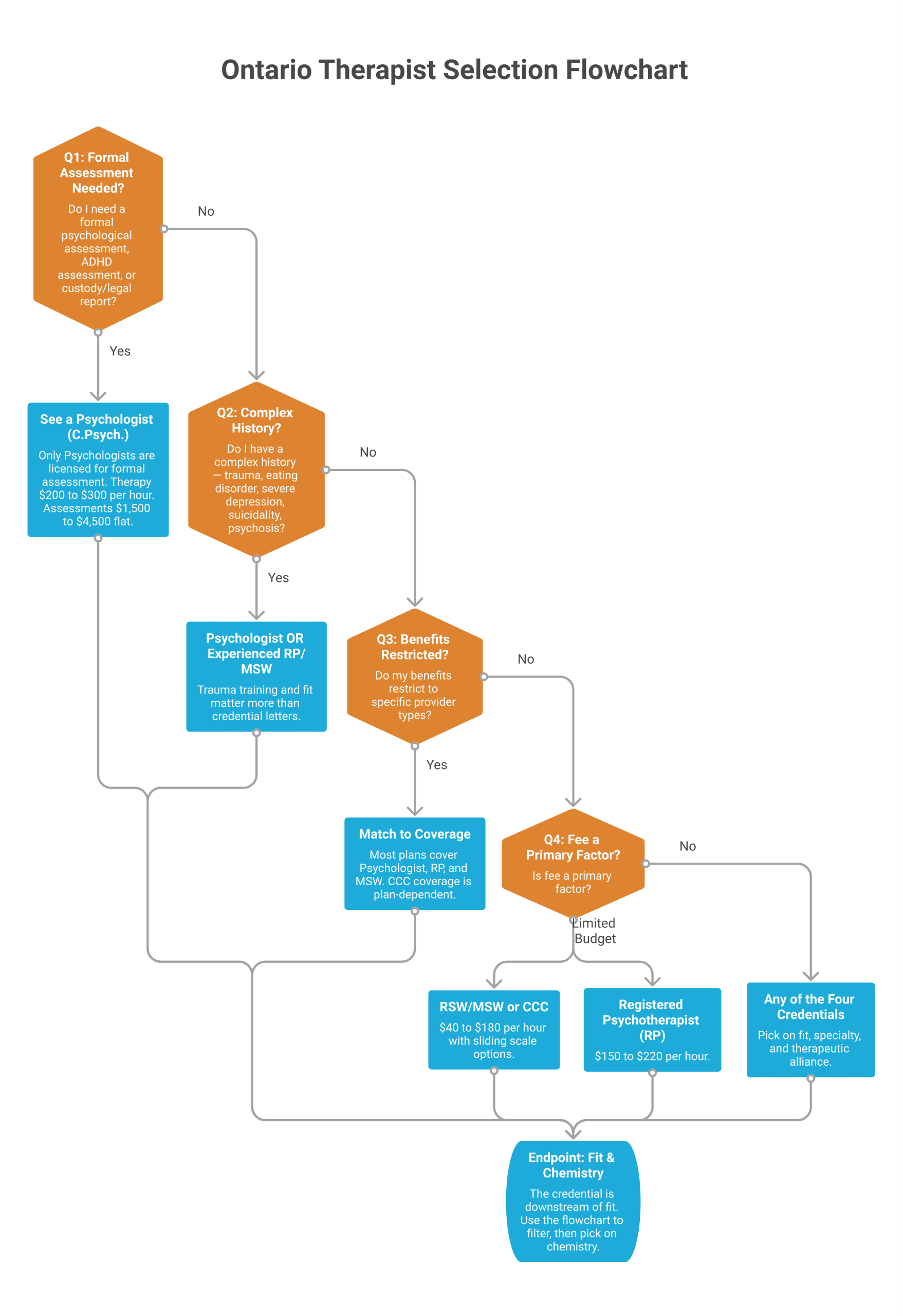
The flowchart maps the four sequential gating questions that filter credentials:
- Q1: Do you need formal psychological assessment? → if yes, Psychologist (only credential authorized).
- Q2: Complex history? → Psychologist or experienced RP/MSW with relevant specialty.
- Q3: Are your benefits restrictive? → match to what’s covered.
- Q4: Is fee a primary factor? → RSW/MSW or CCC for lower cost; RP for moderate; any of the four for higher budgets.
The flowchart is a filter, not a decision. Once you’ve ruled out credentials based on assessment needs, complexity, benefits, and budget, the remaining question is the one this whole guide builds toward: which therapist, of the ones who clear those gates, fits the layer you’re trying to work with?
The credential is downstream of fit. Use the flowchart to filter, then pick on chemistry.
When to Seek a Second Opinion (and Red Flags)
If you’re in therapy and something feels off, the question to ask isn’t “is my therapist bad?”, it’s “is the therapeutic alliance working?”
Three signs the answer is no:
1. You don’t feel safe naming what’s actually happening for you. Therapy depends on you being able to bring the real material to the session. If you’re filtering or performing, telling a sanitized version of the week, holding back the thoughts that feel embarrassing or risky to say out loud, the therapy is happening to a version of you, not the actual you. That’s not necessarily the therapist’s fault; sometimes it’s about your state, not the alliance. But if it persists across multiple sessions, it’s signal.
2. The therapist isn’t curious about you. Good therapists ask questions you didn’t expect. They notice patterns in what you’re saying. They name things you’d been talking around. If your sessions feel like the therapist is filling time, going through scripts, or only following your lead without contributing, the alliance isn’t doing the work.
3. The work isn’t moving. This is the trickiest signal because therapy isn’t always linear; some plateaus are part of the process. But if you’re six to eight sessions in and you can’t articulate what’s changed (in your symptoms, your understanding, your patterns, your relationship to the material), the layer being worked on may not be the right layer.
How to switch without burning the relationship: a healthy “this isn’t working” conversation is direct but not aggressive. “I’ve been thinking about this for a few sessions, and I want to talk about whether the way we’re working is the right fit for what I’m trying to address.” That’s the script. Most therapists hear that as professional and respond clinically, they may suggest adjustments to the work, refer you to a colleague, or affirm that your sense of misfit is valid. Ending a therapeutic relationship well is itself part of the work.
For a second framing of this same dynamic in a different city, the Edmonton walkthrough covers similar territory with its own examples.
Andrea McTague and Brendon Braithwaite walk through the same question from the clinician’s side in Episode 39 of The Shift Show: what a real game plan looks like, how quickly the needle should move, and the questions a competent therapist should be able to answer before you commit. The full conversation and transcript are on the episode page.
Closing
The directory is a starting point. The questions in this guide are the work that makes the directory useful.
If you’re ready to take the next step in Toronto, start with a free 15-minute matching call, fifteen minutes with our intake team to walk through your answers, confirm logistics, and match you to the therapist whose depth, modality, and scheduling fit yours. No therapy commitment at this stage; we move to the actual intake only if the match holds up.
If you’re not ready yet, that’s fine too. Most people who eventually book therapy have an “it’s time” moment that isn’t the first time they considered it. Re-read the five questions in §7. Talk to a friend or partner about what’s coming up. Come back to this guide when you have the answers.
The decisions get easier when the questions are clear. The directory becomes a filter you can actually use, not a list of names you’re guessing between. The therapist you find, whether through us or through any other Toronto practice, is going to work at one of the four layers in §1. The layer that matches what you actually need to change is the one to look for.
That’s the work. The directory comes after.
Specific support, in Toronto
The questions in this guide apply across presentations. If you already know which presentation is closest to what you are carrying, the focused service pages below describe how we work with that specific pattern within the Identity-Level Therapy framework, and what to expect from a first call.
Most common Toronto entry points:
- Anxiety therapy in Toronto, for clients whose presentation is organized around anticipated danger, hypervigilance, or worry that does not quiet through reassurance.
- Depression therapy in Toronto, for clients facing persistent low mood, motivation loss, or a sense of disengagement that has not responded to other approaches.
- ADHD therapy in Toronto, for adults whose attention, executive function, and emotional regulation patterns are interfering with the life they are trying to build.
Other Toronto service pages:
- Trauma therapy · PTSD therapy · OCD therapy
- Stress management therapy · Anger management · BPD treatment
- Self-esteem therapy · Imposter syndrome therapy · Self-harm treatment
- Addiction counselling · Technology addiction therapy · Binge eating disorder treatment
The questions in §7 apply equally across these presentations. The phenomenology differs; the work of finding the right fit is the same.
References
- Horvath, A. O., & Symonds, B. D. (1991). Relation between working alliance and outcome in psychotherapy: A meta-analysis. Journal of Counseling Psychology, 38(2), 139–149.
- Norcross, J. C., & Lambert, M. J. (2018). Psychotherapy relationships that work III. Psychotherapy, 55(4), 303–315.

