
If you’re searching for a therapist in Edmonton, clarity matters. Beyond location and availability, it’s important to understand how therapy is structured, what the plan looks like, and how you’ll know whether progress is happening. Below are the questions many people don’t realize they can, and should, ask before booking their first session.
Table of Contents
Edmonton Therapy: Facts & Essentials
- Typical fees: ~$200–$235 per 50-minute session (aligned with Alberta market guidance).
Who can provide therapy: Registered Psychologists and Registered Social Workers (confirm registration). - Check registration: College of Alberta Psychologists (CAP) • Alberta College of Social Workers (ACSW).
- Insurance: Coverage varies by plan and credential; receipts include session date, fee, provider name, and registration number.
- Public resources (Edmonton): Access 24/7 (Edmonton Zone) • 211 Alberta • Alberta Mental Health Helpline (1-877-303-2642).
Therapist, psychologist, counsellor: what is the difference in Alberta?
The titles blur together, but in Alberta they are not interchangeable.
- Psychologist is a protected, regulated title. Psychologists are registered with the College of Alberta Psychologists (CAP). A Registered Psychologist has completed full registration; a Provisional Psychologist has finished the required education and is completing supervised practice hours toward full registration.
- Social worker, including clinical social workers who provide therapy, is a protected title regulated by the Alberta College of Social Workers (ACSW).
- Counsellor and therapist are broader terms. Some counsellors hold the Canadian Certified Counsellor (CCC) designation through the Canadian Counselling and Psychotherapy Association.
You do not need a doctor’s referral to start with a psychologist, social worker, or counsellor in Alberta. What matters most is that your provider is registered with their regulatory college and works in a structured, accountable way.
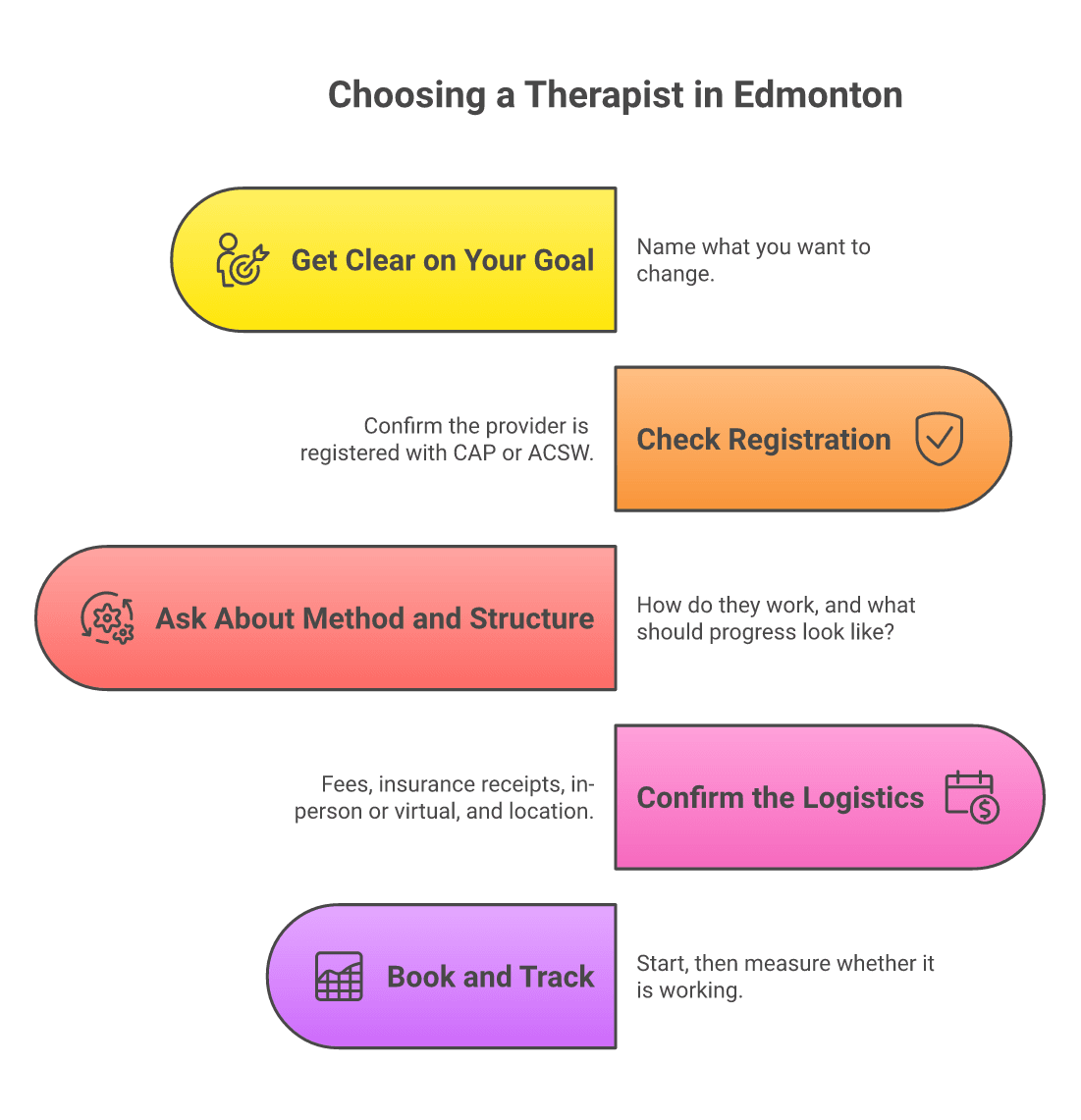
How to Choose a Therapist in Edmonton (Step-by-Step)
Finding a therapist in Edmonton doesn’t have to feel overwhelming. With a clear framework, you can narrow your options and book confidently, knowing what to expect from the process.
Clarify what you want help with.
Start by identifying the primary concerns you’d like to address, for example, anxiety, burnout, relationship tension, executive function challenges, or recurring emotional patterns. The clearer you are about your goals, the easier it is to evaluate whether a therapist’s approach aligns with what you’re looking for.
Confirm credentials and registration.
In Alberta, both Registered Psychologists and Registered Social Workers can provide therapy. You can verify registration through the College of Alberta Psychologists (CAP) or the Alberta College of Social Workers (ACSW). Confirming registration ensures your provider meets provincial standards.
Understand the structure and approach.
Ask how sessions are organized and how progress is evaluated. Some therapy models are open-ended and exploratory; others follow a defined structure. For example, ShiftGrit’s Identity Pattern Therapy uses a structured roadmap that includes intake, belief-mapping, and reconditioning work. Knowing how therapy is organized helps you determine whether the format matches your preferences.
Review logistics and insurance coverage.
Therapy fees in Edmonton generally align with provincial guidance (approximately $220–$235 per 50-minute session). Check your extended health or student plan to confirm coverage limits and eligible credentials. Ensure receipts include session date, fee, provider name, and registration number for reimbursement.
Book an intake session.
A first session gives you insight into communication style, clarity of process, and whether the structure feels appropriate for your goals. You don’t need to have everything figured out before you book, the intake process is designed to help define the path forward.
🧭 Therapist Comparison: Edmonton Options at a Glance
| Designation | What It Typically Means | Typical Fee Range | Notes |
|---|---|---|---|
| Registered Psychologist | Fully licensed clinician regulated by CAP | $235–$245 | Can assess and treat a wide range of concerns |
| Registered Social Worker / Mental Health Therapist | Regulated provider offering counselling services | $144–$229 | Scope varies by training and experience |
| Canadian Certified Counsellor (CCC) | Nationally certified counselling professional | $144–$180 | Not provincially regulated in Alberta |
| Intern Therapist (Supervised) | Clinician in advanced training under supervision | ~$75–$100 | Lower-cost option within a supervised model |
| ShiftGrit Identity-Level Therapy | Structured therapy using the ShiftGrit Core Method™ | Varies by tier | Delivered across provider tiers |
Why “clicking” with your therapist matters less than you would think
Most advice on finding a therapist tells you to keep shopping until you find someone you click with. It is reasonable advice. It is also incomplete.
Here is what the research shows about what moves the needle.
The connection tends to follow the progress, not cause it. In one study of structured therapy for depression, the largest improvements were set up by the work done in session, and clients’ sense of connection strengthened after those gains, not before (Tang and DeRubeis, 1999).
Therapists often cannot tell when therapy is stalling. Across the research, 5 to 14 percent of clients get worse during treatment, and clinicians frequently miss it. Systematically tracking progress can roughly halve that deterioration (Lambert and Shimokawa, 2011).
Measuring progress changes outcomes. A meta-analysis of 24 studies found that routinely measuring a client’s progress, and feeding it back into the work, nearly doubled meaningful improvement among clients who were otherwise headed for a poor outcome (Lambert, Whipple and Kleinstäuber, 2018).
The individual therapist explains less than you would expect. Across six clinical trials and 4,549 clients, the specific therapist accounted for only a small share of how people did, and adding progress feedback narrowed the gap between more and less effective therapists by roughly 18 percent (Delgadillo et al., 2022). Years of experience alone do not reliably make a therapist more effective; in one Calgary agency, what improved results over seven years was systematic measurement and structured practice (Goldberg et al., 2016).
What does carry weight is the method, delivered well. How competently and faithfully a treatment is delivered is linked to outcomes to a degree comparable with the relationship factors therapists usually emphasize (Power et al., 2022). And in structured therapies, how much and how well clients do the work between sessions is associated with better results (Kazantzis et al., 2016).
Think of it the way you would think about surgery. You do not need to feel a personal bond with your surgeon. You need a competent one following a procedure that works. Researchers describe a “surgeon effect” on outcomes that mirrors the known “therapist effect,” where results vary by practitioner in ways their experience alone does not explain (Schnelle et al., 2022).
None of this means the relationship does not matter. It means the relationship is not the thing to screen hardest for.
This is why ShiftGrit runs a structured, goal-oriented program with progress measurement built in. When the method does the heavy lifting and your progress is tracked session by session, you are choosing a defined process, not gambling on chemistry.
Red flags when choosing a therapist
A few signs are worth taking seriously:
- They will not clearly explain their approach or what progress should look like.
- There is no way to tell whether therapy is working. Good practice includes some form of progress tracking.
- They talk more about themselves than about your goals, or cannot accept questions and feedback.
- They are vague about their registration or credentials.
- They promise a guaranteed cure or a fixed timeline. Responsible, regulated providers do not guarantee outcomes.
Most of these come back to the same thing: a lack of structure and accountability.
Fees, Insurance, and Receipts in Edmonton
Therapy is an investment of both time and resources. In Alberta, many clinics reference guidance from the Psychologists’ Association of Alberta (PAA), which recommends $235 for a 50-minute session (effective January 1, 2025). Individual providers may set fees above or below this benchmark depending on designation, experience, and structure.
At ShiftGrit Edmonton, fees vary by provider tier. See how our pricing works below.
- Registered Psychologists generally align with provincial guidance.
- The same structured method is delivered across every tier.
- Reduced-rate sessions with supervised clinicians are available at a lower fee point to support accessibility.
Before booking, we encourage clients to confirm their extended health coverage, including eligible designations and annual limits.
All sessions include detailed receipts with:
- Session date
- Provider name
- Professional designation
- Registration number
- Fee paid
This ensures documentation is ready for insurance reimbursement where applicable.
Transparent pricing allows clients to make informed decisions about their care, without uncertainty about session costs or billing structure.
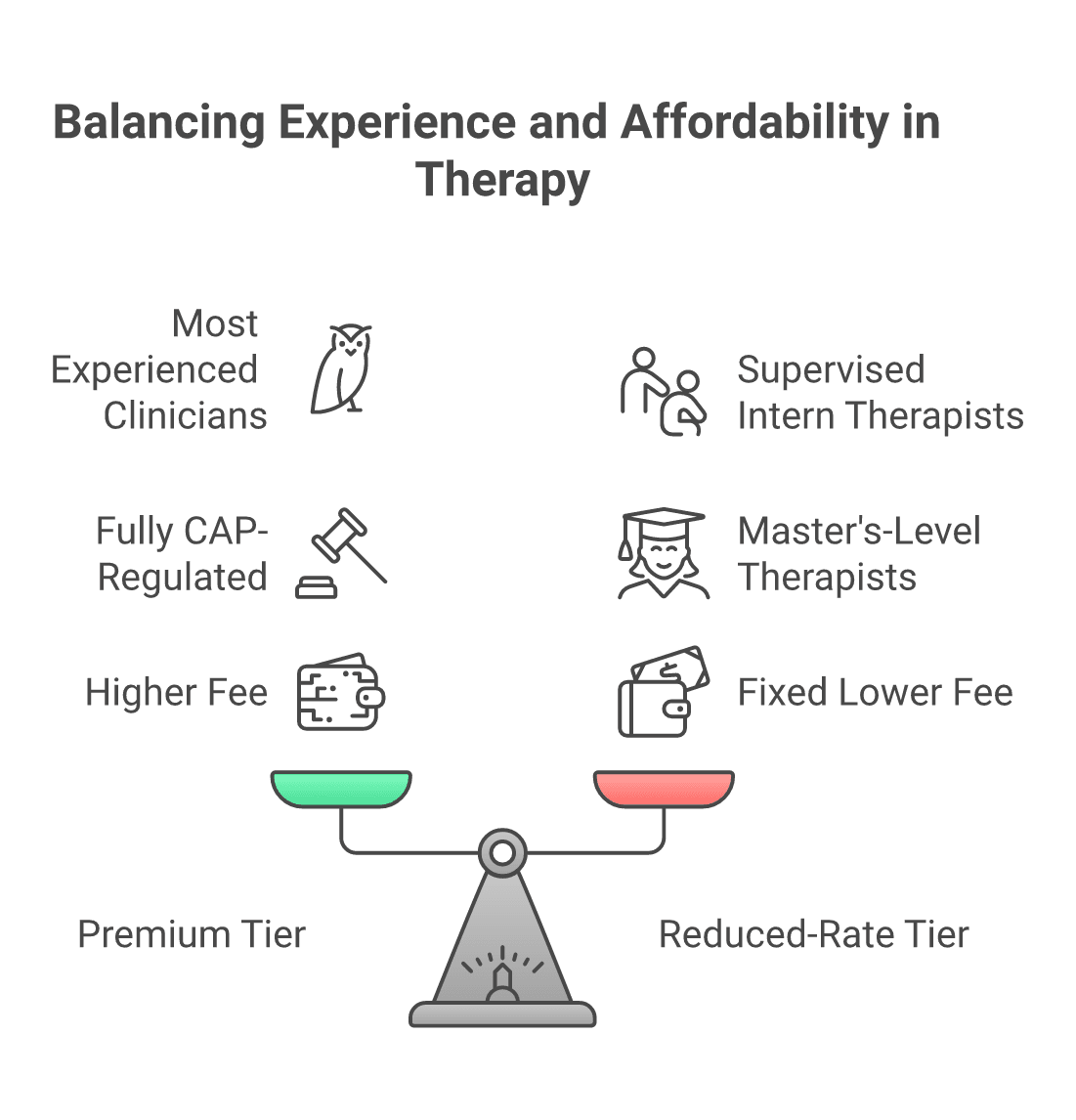
How ShiftGrit pricing works
Every tier delivers the same structured method. What changes is the clinician’s training, experience, and level of supervision, and the fee.
- Premium: our most experienced clinicians, fully regulated by the College of Alberta Psychologists.
- Standard: licensed or provisionally licensed clinicians delivering the same structured, evidence-based therapy.
- Reduced-Rate: master’s-level therapists and supervised intern therapists at a fixed lower fee, to keep access open. Intern Therapist sessions are not eligible for insurance reimbursement.
You will see the exact fee for each provider when you book, and every eligible session comes with a receipt for insurance.
Free and lower-cost mental health support in Edmonton
Private therapy is not the only route. A few options worth knowing:
- Access 24/7 (Alberta Health Services, Edmonton Zone) offers assessment and connection to mental health services.
- Alberta Mental Health Helpline: 1-877-303-2642, available 24/7.
- 211 Alberta: dial 2-1-1 for community and social services.
- Edmonton Distress Line: 24-hour crisis support.
- Community and training clinics offer sliding-scale or reduced-fee counselling.
If you are in crisis or thinking about suicide, call or text 988, the Suicide Crisis Helpline, available across Canada.
In-Person vs Virtual Therapy in Edmonton: What’s the Right Fit?
In-person (124 Street, Westmount):
Our Edmonton office is located in the Westmount community along 124 Street, a walkable area with nearby cafés, local shops, and accessible street parking. In-person sessions offer a private, dedicated space away from daily distractions, which some clients find helpful for focus and containment.
Virtual:
Virtual sessions follow the same structured Identity-Level Therapy process, delivered securely from your home or office. Many Edmonton clients appreciate the flexibility, particularly during winter months, busy workweeks, or when commuting from areas like St. Albert or Sherwood Park.
Both formats follow the same therapeutic framework. The choice often comes down to preference, schedule, and what environment feels most supportive for you.
When to Switch Therapists (And How to Do It Thoughtfully)
It’s common advice: “If it doesn’t feel like a fit, switch.” That guidance can be helpful, but it’s also worth understanding what “fit” actually means in therapy.
Therapeutic fit includes communication style, pacing, and whether you feel understood. Structure also matters, knowing how sessions are organized and how progress is being approached.
If you’re considering switching therapists, you might reflect on:
- Do I understand the treatment plan?
- Do I feel clear about what we’re working toward?
- Is the structure aligned with how I prefer to work?
At ShiftGrit Edmonton, therapy is organized around a defined framework. Because sessions follow a mapped process, including belief inventory and structured therapeutic work, documentation and planning can transfer between providers within the clinic when appropriate.
This means that if a client chooses to switch clinicians internally, the foundational work does not need to be repeated unnecessarily. The overall roadmap remains intact.
Switching therapists, whether within a clinic or elsewhere, is a normal part of the therapeutic process for some individuals. The goal is not perfection in fit, but clarity in direction and comfort with the process.
How You’ll Know Therapy Is Working
We explore these shifts in more detail throughout our Edmonton therapy guides. Progress in therapy doesn’t always look dramatic, it often shows up in quieter moments when you notice you’re responding differently than you used to.
Clients commonly describe signs of traction such as:
- Pausing before reacting and feeling more choice in what comes next
- “I should” or “I can’t” thoughts softening into more flexible alternatives
- Stressful events lingering for a shorter period of time
- Triggers feeling informative rather than overwhelming
- Greater clarity about patterns that once felt automatic
These changes tend to reflect increased awareness, emotional flexibility, and improved regulation under pressure.
That’s how Identity-Level Therapy and structured reconditioning work can translate into meaningful, real-world shifts.
Andrea McTague and Brendon Braithwaite walk through the same question from the clinician’s side in Episode 39 of The Shift Show: what a real game plan looks like, how quickly the needle should move, and the questions a competent therapist should be able to answer before you commit. The full conversation and transcript are on the episode page.
Edmonton Neighbourhood Notes (124 Street / Westmount) & Parking
Logistics matter. Our Edmonton office is located on 124 Street in the Westmount community, a well-known central corridor with local cafés, boutiques, and walkable access.
Clients can expect:
- Convenient street parking nearby
- A professional, private office environment
- Evening and select weekend availability
If you’re commuting from surrounding areas like St. Albert, Sherwood Park, or Glenora, in-person sessions remain accessible. For those balancing work schedules or winter driving conditions, virtual sessions offer added flexibility.
Whether you prefer stepping into a dedicated space on 124 Street or connecting from home, both formats follow the same structured therapy process.
How to Book (And What to Expect)
Step 1: Check availability online.
View current openings for our Edmonton providers and choose a clinician that fits your preferences.
Step 2: Book a 50-minute intake session.
Your intake is a focused starting point designed to clarify goals, outline the structure, and determine next steps.
Step 3: Come prepared to explore patterns.
You don’t need to know exactly where to begin, the intake process is structured to guide that conversation.
Booking is designed to be straightforward and transparent. You’ll receive confirmation details and intake information in advance so you know what to expect.
Identity-Level Therapy in Edmonton
Identity-Level Therapy targets the belief patterns and emotional loops driving automatic reactions—not just the surface symptoms. By working at the identity layer, clients shift how they interpret safety, regulate threat, and relate to themselves and others. The result: reconditioning at the root of shame, self-sabotage, reactivity, and overwhelm.
It’s organized around three pillars:

ShiftGrit Core Method™
Our structured framework for breaking outdated identity patterns.
Learn More
The Pattern Library
Real-world examples of loops like perfectionism, procrastination, and shutdown.
Learn More
The Glossary
Clear definitions that keep the language sharp and the process transparent.
Learn More“What’s your approach, and how will we track progress?”
Most people never ask this. They assume therapy means talking until you eventually “feel better.” But insight and progress aren’t always the same thing, and it’s completely reasonable to ask how your therapist structures the work.
If you’re interviewing a therapist in Edmonton, ask:
“What’s your process? What will our first few sessions focus on, and how will we know we’re on track?”
A helpful answer usually includes some combination of:
- how sessions are structured (agenda, focus, and goals)
- how the therapist decides what to prioritize
- what “progress” tends to look like in real life
- how you’ll review what’s changing over time
At ShiftGrit, our work is structured around Identity Pattern Therapy and the ShiftGrit Core Method™, a clear roadmap that helps clients understand the belief patterns behind anxiety, burnout, reactivity, and stuck cycles. We aim to be transparent about the plan, the rationale behind it, and what each phase of therapy is intended to do.
Rather than leaving sessions open-ended, we use a defined process that typically includes:
- a focused intake and pattern-mapping phase, and
- structured therapeutic work that targets the automatic loops keeping the pattern in place.
✅ Summary:
Finding a therapist in Edmonton isn’t only about location or price. It’s about choosing an approach that feels clear, structured, and aligned with what you want help with, so you’re not guessing what each session is building toward.
What Structured Identity-Level Therapy Looks Like
Understanding the structure of therapy can make the process feel more grounded and transparent. Here’s how Identity Pattern Therapy is typically organized at ShiftGrit Edmonton.
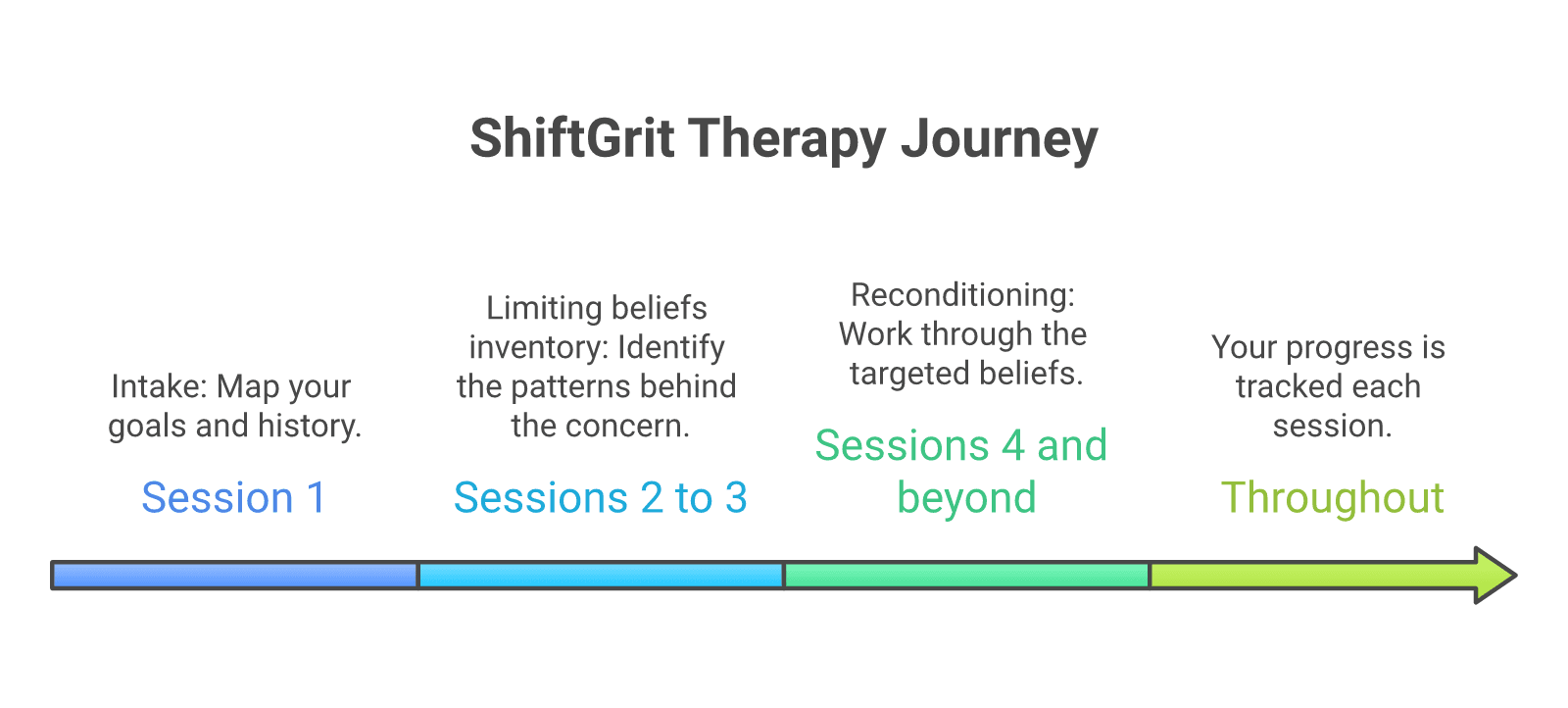
Session 1 – The Intake
Your first session is a focused 50-minute intake. We explore current stressors, recurring triggers, emotional patterns, relationship dynamics, and relevant developmental history.
The goal isn’t simply to “tell your story.” It’s to begin identifying the core belief patterns that may be shaping automatic reactions, such as “I am not good enough” or “I am defective”, and to outline a clear therapeutic roadmap.
You leave knowing what we’re looking at and why.
Sessions 2–3 – Limiting Beliefs Inventory
In the next phase, we map patterns more precisely.
We identify:
- recurring emotional loops
- belief themes that generalize across situations
- coping strategies such as perfectionism, people-pleasing, withdrawal, or conflict avoidance
Clients often describe this phase as “seeing the blueprint.” The patterns begin to make sense as a system rather than isolated problems.
Sessions 4 and Beyond – Reconditioning
Once patterns are clearly identified, therapy shifts toward structured experiential work.
Using established therapeutic techniques, we work to reduce the emotional intensity associated with old learning and perceived threats. The goal is to help the nervous system respond more proportionately in the present.
Rather than trying to suppress reactions, the work focuses on recalibrating how those reactions are triggered.
Over time, clients may notice:
- increased pause before reacting
- shorter emotional “hangovers”
- more flexibility in high-pressure situations
Transparent Plan: Session Structure & Pacing
When starting therapy in Edmonton, one of the most important questions to ask is how the process will be structured over time.
Some therapy models are intentionally open-ended and exploratory. Others are more structured and phase-based. Neither approach is inherently better, but they feel very different as a client experience.
At ShiftGrit, we prioritize transparency around structure. Clients are walked through what each phase of therapy is designed to focus on, why certain patterns are being targeted, and how sessions build on one another.
Rather than wondering what each week will involve, you can expect:
- a defined intake and mapping phase
- a clear explanation of identified belief patterns
- structured therapeutic work aimed at reducing automatic emotional reactivity
- periodic review of progress and direction
Therapy timelines vary depending on goals, complexity, and individual pace. Some clients work briefly on a focused issue; others choose longer-term work to address deeper identity-level patterns. The emphasis is not on speed, but on working at a level that supports meaningful and sustainable change.
Clarity around the roadmap helps reduce uncertainty, and allows clients to make informed decisions about their investment of time and energy.
Book with a registered therapist or psychologist in Edmonton
Explore our Edmonton clinicians, learn about their training and areas of focus, and book online when you’re ready.
Browse profiles, watch introduction videos, and select the provider tier that aligns with your preferences and availability. Meet a few of our clinicians and learn what to expect in your first session.
Browse profiles, watch intro videos, and book online when you’re ready.













See all Edmonton therapists & book your first session →
Explore Edmonton therapy by concern
Once you know what you want to work on, these Edmonton guides go deeper:
- Anxiety therapy in Edmonton
- Depression therapy in Edmonton
- ADHD therapy in Edmonton
- Trauma therapy in Edmonton
- OCD therapy in Edmonton
- PTSD therapy in Edmonton
- Self-esteem therapy in Edmonton
Want to understand our approach? Learn about Identity-Level Therapy, or read our guide to finding a therapist in Calgary.
How much does therapy cost in Edmonton?
What’s the difference between a psychologist and a counsellor in Edmonton?
How do I know if a therapist in Edmonton is registered?
How many therapy sessions will I need?
Does insurance cover therapy in Edmonton?
Is virtual therapy as effective as in-person therapy?
What should I expect in my first therapy session?
How do I choose the right therapist in Edmonton?
What is Identity-Level Therapy?
When should I consider switching therapists?
How much does therapy cost in Edmonton?
What are red flags when choosing a therapist?
Is there a 'best' therapist in Edmonton?
Shift Show Episode, Mind Over Money
If you’d like a deeper look at the belief patterns behind financial anxiety, listen to the Shift Show episode:
🎙️ Mind Over Money (Podcast Episode)
References & Community Resources
We believe in transparent, evidence-informed care. The following open-access resources may complement the work you do in therapy:
- MyHealth Alberta: Tips for Finding a Counsellor or Therapist
- Alberta Health Services – Help in Tough Times: Addiction & Mental Health Supports
- BounceBack Alberta: Free guided self-help program for individuals 15+ experiencing mild to moderate anxiety or depression
- Tang T. Z., DeRubeis R. J. (1999). Sudden gains and critical sessions in cognitive-behavioral therapy for depression. J. Consult. Clin. Psychol., 67, 894-904. DOI
- Lambert M. J., Shimokawa K. (2011). Collecting client feedback. Psychotherapy, 48, 72-79. DOI
- Lambert M. J., Whipple J. L., Kleinstäuber M. (2018). Collecting and delivering progress feedback: a meta-analysis of routine outcome monitoring. Psychotherapy, 55, 520-537. DOI
- Delgadillo J., et al. (2022). Progress feedback narrows the gap between more and less effective therapists. J. Consult. Clin. Psychol., 90, 559-567. DOI
- Power N., et al. (2022). Associations between treatment adherence-competence-integrity and adult psychotherapy outcomes. J. Consult. Clin. Psychol., 90, 427-445. DOI
- Goldberg S. B., et al. (2016). Creating a climate for therapist improvement. Psychotherapy, 53, 367-375. DOI
- Schnelle C., et al. (2022). Is there a surgeons’ effect on patients’ physical health, beyond the intervention? Ther. Clin. Risk Manag., 18, 467-490. DOI
- Kazantzis N., et al. (2016). Quantity and quality of homework compliance: a meta-analysis of relations with outcome in CBT. Behav. Ther., 47, 755-772. DOI
If you require immediate mental health support in Alberta, call 211 or visit Help in Tough Times for crisis and urgent care resources.