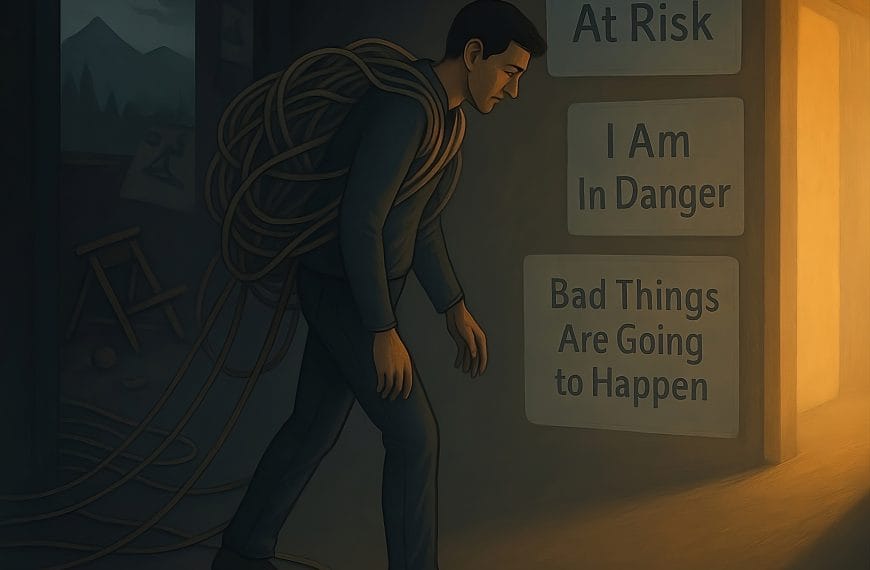
Edmonton’s professional landscape is dense with formal feedback culture. Government performance reviews, engineering peer reviews, healthcare audits, academic evaluations — sectors that don’t just permit critique, they require it. For most people, that’s manageable. For Edmonton adults with ADHD, particularly those with Rejection Sensitive Dysphoria (RSD) patterns, formal feedback can feel less like a workplace ritual and more like a recurring nervous-system threat.
This article explains what rejection sensitivity actually is, why ADHD brains amplify it, why Edmonton’s feedback-heavy professional cultures keep activating it, and how Identity-Level Therapy works on the pattern underneath the reaction.
Table of Contents
What Rejection Sensitivity Looks Like in ADHD
Rejection sensitivity isn’t weakness or thin skin. It’s a real pattern of intense emotional response to perceived criticism, exclusion, or disapproval — often disproportionate to the triggering event. For ADHD adults, the intensity can be physical: a hot rush, a stomach drop, an automatic urge to defend, withdraw, or over-explain. The trigger doesn’t have to be a real rejection. A neutral comment, an unanswered email, a vague tone in a meeting can each set off the same response.
Why Edmonton’s Workplace Cultures Activate It
1. Government and Public-Sector Hierarchies Are Built on Documented Feedback
If you work in provincial government, municipal services, healthcare administration, or post-secondary institutions, your professional life is structured around documented evaluations: annual reviews, mid-year check-ins, project debriefs, complaint reviews. Each is a moment when feedback is captured in writing and circulated. For ADHD professionals with rejection-sensitive patterns, those moments become months-long anticipatory loops.
2. Engineering and Technical Sectors Run on Peer Critique
Edmonton’s engineering, oil-and-gas technical services, and software corridors operate on peer-review culture. Code reviews, design reviews, calculation checks, drawing approvals — every meaningful piece of work passes through critique by another professional. Healthy critique culture is part of why these sectors function. But for someone with RSD, every red comment in a review feels disproportionately personal.
3. Healthcare and Education Carry High-Stakes Public-Facing Feedback
Patient complaints, parent communications, student evaluations, public-record decisions — Edmonton’s healthcare and education professionals work in environments where critique can become public, official, and lasting. The body learns to brace for the next message before it arrives.
4. Long Winters Compound Recovery Time Between Activations
When the seasonal context already adds emotional load (less light, less social, less movement), the time it takes to recover from a rough feedback moment lengthens. By February, many Edmonton ADHD professionals describe feeling chronically braced — never fully reset between feedback cycles.
Why Generic Coping Strategies Fall Short
The standard advice — “don’t take it personally,” “focus on the content not the tone,” “practise grounding before reviews” — addresses the surface response. It doesn’t reach the pattern that produces the response in the first place.
- Reframing helps in the moment, but doesn’t prevent the next activation.
- Mindfulness reduces intensity, but doesn’t change what triggers it.
- Talk-back scripts work when prepared, but the pattern fires faster than language.
- “Just don’t care so much” — not how nervous-system responses work.
Identity-Level Patterns Underneath Rejection Sensitivity
Three patterns surface most often when Edmonton ADHD clients work on rejection sensitivity in therapy.
Pattern 1: “If they criticise me, I’ve failed as a person.”
Identity is fused with performance. The brain reads professional feedback as a comprehensive verdict on who you are, not on a discrete piece of work.
Pattern 2: “People are about to figure out I don’t belong here.”
Common in high-achieving ADHD professionals. Each piece of feedback feels like a breadcrumb leading to the moment your competence gets exposed.
Pattern 3: “I should be handling feedback like everyone else does.”
The secondary suffering pattern. The shame about feeling so much about feedback eclipses the feedback itself.
How Identity-Level Therapy Helps
Identity-Level Therapy doesn’t teach you to “care less.” It works on the belief patterns that determine why feedback activates the threat system in the first place.
- Mapping the specific identity belief feedback is currently triggering for you.
- Identifying the origin — usually a learning history that predates ADHD diagnosis.
- Reconditioning the pattern with the ShiftGrit Core Method™ so the same feedback stops generating the same internal storm.
Identity-Level Therapy for Rejection Sensitive Dysphoria in Edmonton
Identity-Level Therapy targets the belief patterns and emotional loops driving automatic reactions—not just the surface symptoms. By working at the identity layer, clients shift how they interpret safety, regulate threat, and relate to themselves and others. The result: reconditioning at the root of shame, self-sabotage, reactivity, and overwhelm.
It’s organized around three pillars:
ShiftGrit Core Method™
Our structured framework for breaking outdated identity patterns.
Learn More
The Pattern Library
Real-world examples of loops like perfectionism, procrastination, and shutdown.
Learn More
The Glossary
Clear definitions that keep the language sharp and the process transparent.
Learn MoreLimiting Beliefs Commonly Linked with Rejection Sensitive Dysphoria Therapy
These identity-level patterns frequently show up for clients seeking rejection sensitive dysphoria therapy. Explore the beliefs to learn the “why” and how therapy can help you recondition them.

“I Am Unwanted”
The “I Am Unwanted” belief doesn’t just hurt — it wires the nervous system to expect rejection and chase approval. ShiftGrit targets the root pattern, not just the…
Explore this belief
“I Am Excluded”
You don’t need to be left out to feel it. This belief wires you to expect exclusion — even in silence, glances, or group chats. But that expectation…
Explore this belief
“I Am Not Good Enough”
“I’m Not Good Enough” isn’t just a negative thought — it’s a pattern formed by early experiences like criticism, neglect, or impossible expectations. This belief fuels perfectionism, people-pleasing,…
Explore this beliefWant to see how these fit into the bigger pattern map? Explore our full Limiting Belief Library to browse all core beliefs by schema domain and Lifetrap.
When the Pattern Changes, Feedback Stops Feeling Like a Verdict
Clients often describe their first review post-therapy as “the first one I survived without three days of rumination after.” Same review process. Same feedback. Different pattern underneath.
If Feedback Hits You Hard in Edmonton, There’s a Reason — And It’s Not Weakness
ADHD rejection sensitivity is real, well-documented, and pattern-driven. Edmonton’s professional cultures amplify it, but they don’t cause it. The pattern is workable. Our Edmonton therapists and Edmonton ADHD therapy team are trained in the ShiftGrit Core Method™ and can guide you through structured work on the patterns underneath the reaction.
RSD episodes leave behind pattern-level activation that doesn’t always settle on its own. Our Edmonton anxiety therapy team handles the residual anxiety pattern that builds when feedback events recur.