Your reactions aren’t random. They’re patterned.
At ShiftGrit, Pattern Theory™ is one of the core pillars of our Identity-Level Therapy approach. It offers a structured, clinically informed framework for understanding how early experiences quietly sculpt the beliefs that drive how we think, feel, and behave in adulthood.
These patterns aren’t conscious choices. They’re automatic loops that run beneath the surface — until we dissolve them at their source.
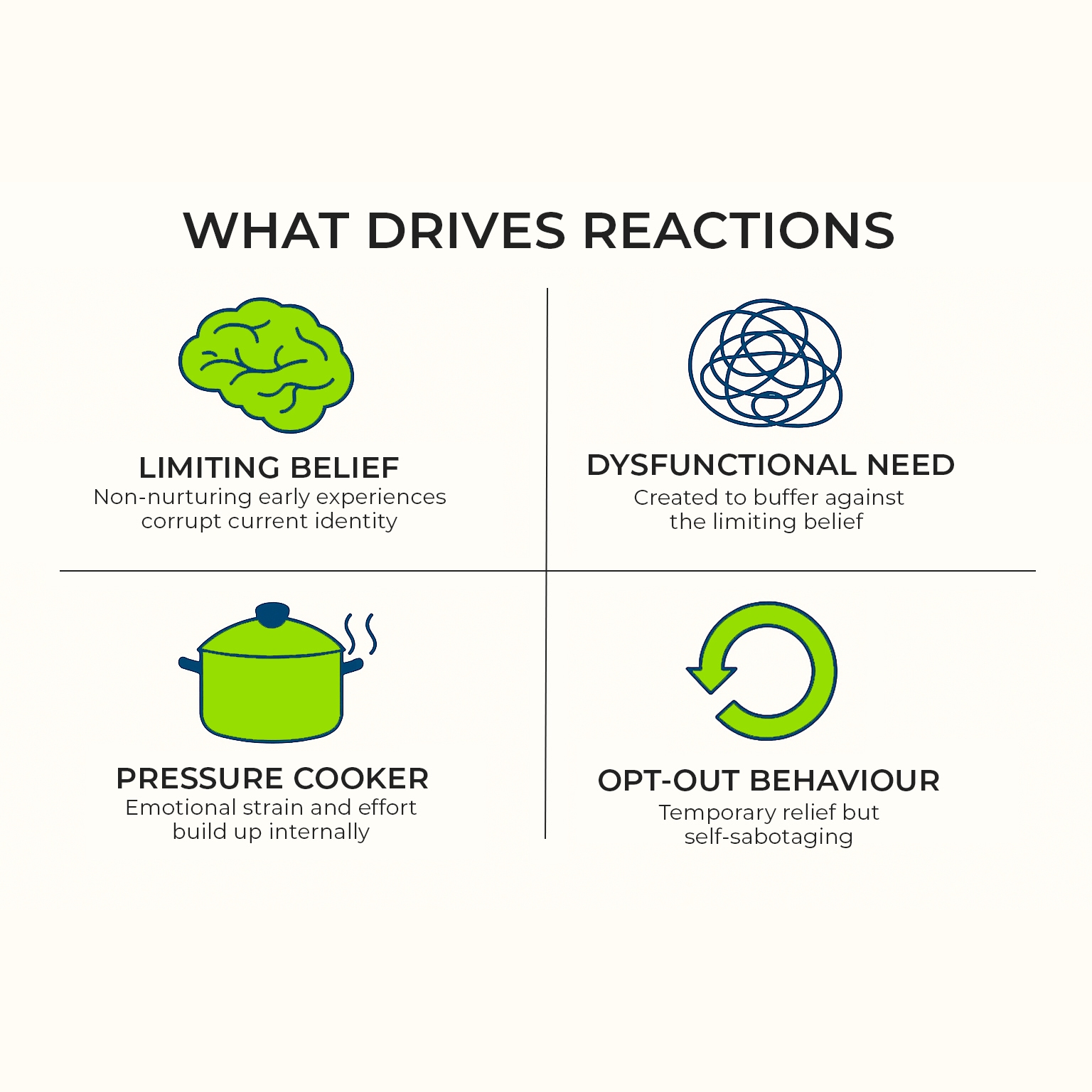
This visual breaks down the four key components of Pattern Theory™:
The Anatomy of a Pattern
Pattern Theory™ breaks down into four interlocking parts:
- Rooted in early non-nurturing experiences, a limiting belief is a core lens through which you interpret yourself and the world. (Example: “I’m not good enough.”)
- To buffer against the pain of the limiting belief, the mind creates a compensatory drive. (Example: “I need to be perfect.”)
- Emotional tension builds internally as you strive to meet the dysfunctional need, while suppressing the discomfort of the original limiting belief.
- When the pressure becomes too great, an escape behaviour emerges — like avoidance, shutdown, or emotional outbursts. This opt-out provides short-term relief but ultimately reinforces the limiting belief.
Pattern Theory™ overview
This page defines the term at a high level.
For the full explanation of Pattern Theory™ as a diagnostic component of the ShiftGrit Core Method™, visit the Pattern Library.
Pattern Library
Patterns people seek therapy for — explored at the level where real change begins.
Stuck Between the Life You Have and the One You’d Choose
This pattern often feels less like a dramatic crisis and more like a private stalemate between two legitimate lives. The life you have is built: work, relationships, geography, routines, responsibilities, and history all make...
Learn more
Trading Long-Term Stability for Short Bursts of Relief
Often this trade does not feel like a trade in the moment. It can look like one more deposit, one more night, or one more attempt to turn the day around. The relief is real: tension drops, attention narrows, hope briefly rise...
Learn more
The Weekend Crash After Holding It Together
For some people, the weekend crash does not feel like rest finally arriving. It feels like the body presenting the bill for a week spent being composed, useful, and in motion. During the week they answer messages, make decisi...
Learn more
Feeling Like a Burden for Having Needs
For some people, this is not just being private or independent. It is a steady background conviction that needing support, attention, reassurance, time, or repair makes them too much for other people. A simple text asking for...
Learn more
Still Expecting the Group to Turn on You
Earlier bullying or exclusion can teach your system that groups can shift against you without much warning. In adult rooms, small cues such as delayed laughter, a quiet group thread, a glance between two people, or a change i...
Learn more
Starting Strong, Struggling to Sustain
The beginning is often the most reliable part of this pattern. A new project, role, hobby, or relationship can create instant focus, fast ideas, and a burst of progress that feels convincing to both you and other people. The ...
Learn moreNew patterns are added to the library each week. If you don't see yours here today, check back soon.
From Insight to True Change
Understanding your patterns is powerful. But understanding alone doesn’t create change.
At ShiftGrit, we go further. We use a structured process of Enriched Intake, Pattern Mapping, and Reconditioning to actively dissolve the identity-level patterns that drive unwanted emotional, cognitive, and behavioural loops.
We don’t teach you to cope with your patterns. We teach your mind to no longer generate them.
This is the ShiftGrit Core Method™:
- Systematic pattern identification
- Targeted emotional reconditioning
- Identity-level transformation that becomes automatic and self-sustaining
Limiting Beliefs in Pattern Theory™
Core Beliefs are the building blocks of Pattern Theory™. They grow out of Non-Nurturing Elements™ and form repeating loops that shape identity and behaviour.
FAQ
Curious about how Identity Pattern Therapy works and whether it’s the right fit for you? Here are answers to some of the most common questions we hear from new clients.
What is Pattern Theory™ in therapy?
What are examples of limiting beliefs?
How do dysfunctional needs™ develop?
Why do patterns feel so automatic?
Can you really dissolve these patterns?
Ready to see how we apply Pattern Theory™ to create lasting identity-level change?
➔ Learn about Identity Pattern Therapy here.
Find the pattern behind what's been feeling hard
A few simple questions to help surface the concerns that may fit best.
Find Your Pattern