In-Person & Virtual Therapy

Trauma Therapy in Edmonton

Published Updated
Book Online

Does any of this sound like you?

  • Your body braces before your mind registers a threat. Tight shoulders walking into a meeting on 124 Street, jaw locked at the kitchen table, a chest that will not soften even on a quiet evening.
  • You go numb or feel oddly disconnected during stress, like you are watching yourself from a distance while a meeting, a conversation, or a drive home happens around you.
  • You scan rooms, exits, faces, and tones for threat constantly, even in low-stakes Edmonton settings, a Whyte Ave cafe, a Garneau classroom, a regular shift at work.
  • Intrusive images, fragments, or body sensations arrive without warning, sometimes triggered by ordinary things like a smell on a winter coat, a song, or a particular tone of voice.
  • You avoid people, places, conversations, or sensations that are objectively safe but that your system codes as risky. River valley walks you used to enjoy, certain neighbourhoods, certain rooms in your own home.
  • Your body has developed patterns your physician cannot fully explain. Sleep that will not consolidate, digestive issues that shift with stress, chronic tension that massage and exercise do not resolve.

About this service

Trauma in Edmonton walks into the 124 Street offices wearing a lot of disguises. It shows up as a U of A grad student who freezes in seminar rooms for reasons that have nothing to do with the seminar. It shows up as an AHS nurse who cannot wind down after a code, even days later. It shows up as a Westmount parent who is gentle with their kids and brutal with themselves. The patterns differ. The underlying signature, a nervous system stuck protecting against something that is no longer happening, is consistent.

ShiftGrit’s Edmonton clinic at 10445 124 Street offers trauma therapy that treats the installed belief patterns alongside the body’s stress response. Our Identity-Level Therapy category of approaches works on the level of identity-installed beliefs, not just symptom management. Sessions move at the pace your nervous system can tolerate, with the option to work through patterns without recounting traumatic events in full detail.

If you are in acute crisis or active flashbacks that are impairing daily function, please contact Edmonton’s Access 24/7 line at 780-424-2424 or 988 before starting outpatient work. Trauma therapy is most effective when baseline safety is established first.

Types of trauma we treat

Single-incident trauma

One discrete event the system has not finished processing. A motor vehicle collision on the Yellowhead, a workplace incident, an assault, a medical emergency. The event is bounded in time. The installed belief is often "I Am Vulnerable" or "I Am Not in Control" generalizing beyond the original context.

Developmental / Childhood trauma (C-PTSD-adjacent)

Patterns installed before the nervous system had adult regulation tools. Often relational, often chronic, often pre-verbal. The work moves slower than single-incident trauma and benefits from the client-led pacing model. Belief installations tend to be identity-level rather than situational.

Relational trauma

Damage that arrived inside a close relationship: a partner, a parent, a sibling, a long-term colleague, a faith community. The installed belief frequently sits on the trust and worth axis. Sessions address the pattern without requiring the other person to be present or to acknowledge anything.

Medical trauma

Installed during prolonged illness, ICU stays, difficult births, cancer treatment, or repeated procedures. The body learned that being touched, monitored, or examined preceded pain or fear. Common with clients who interface heavily with the AHS system as patients and now struggle with routine appointments.

Witness trauma / vicarious trauma

Carried by those who repeatedly absorb other people's worst moments: AHS frontline staff, Edmonton fire and EMS, social workers, U of A faculty in clinical fields. The installation is real even though the practitioner was never the direct target. Often shows up as numbing, cynicism, or sleep collapse.

Intergenerational trauma

Patterns transmitted through family system, parenting style, and embodied modelling rather than a single incident the client experienced. Common when the parent or grandparent generation carried unaddressed trauma. The work targets the pattern as the client holds it now, not the original source.

Identity-based trauma

Cumulative damage tied to race, gender, sexual orientation, faith background, or disability. Distinct from single events because the threat is ongoing and structural. The work does not pathologize the client's response. It addresses the specific installed beliefs while honouring the realistic risk landscape.

Deep dive

Trauma


Identity-Level Therapy for Trauma in Edmonton

Identity-Level Therapy is a category of belief-pattern approaches that targets the safety, trust, worth, and control beliefs trauma installs, while pacing nervous-system regulation alongside the work.

It’s organized around three pillars:


Limiting Beliefs Commonly Linked with Trauma Therapy

These identity-level patterns frequently show up for clients seeking trauma therapy. Explore the beliefs to learn the “why” and how therapy can help you recondition them.

Core Belief Id – “I Am In Danger” – ShiftGrit Periodic Table of Limiting Beliefs

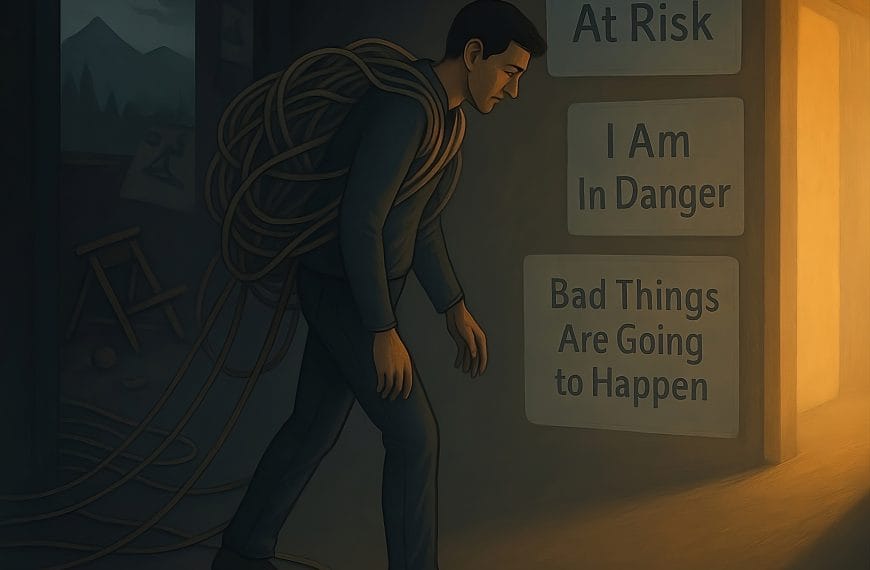
“I Am In Danger”

Even when everything’s quiet, your body stays braced. The belief “I Am In Danger” forms in environments where trauma, chaos, or emotional instability made safety feel impossible. It…

Explore this belief
Visual belief card labelled “I Am Powerless” — part of ShiftGrit’s limiting belief schema.

“I Am Powerless”

The belief “I Am Powerless” often forms in environments where autonomy was suppressed and safety depended on submission. It creates chronic helplessness, low agency, and difficulty asserting needs…

Explore this belief
Limiting belief tile for “I Am At Risk” with an orange background, representing anxiety, vigilance, and safety-seeking behaviours.

“I Am At Risk”

“I Am At Risk” is a core belief rooted in environments where safety felt unpredictable. It often drives patterns of anxiety, catastrophic thinking, and compulsive control.

Explore this belief

Want to see how these fit into the bigger pattern map? Explore our full Limiting Belief Library to browse all core beliefs by schema domain and Lifetrap.


Program Overview

Trauma installs beliefs. That is the operating principle behind how ShiftGrit’s Edmonton trauma program is structured. After a frightening, prolonged, or relationally damaging experience, the nervous system extracts conclusions and stores them as if they were facts about the world. Common installations include “I Am Not in Control”, “I Am Vulnerable”, and “I Am Permanently Damaged”. These are not character flaws and they are not failures of resilience. They are the residue of a system that did its job.

Identity-Level Therapy is a category of approaches, not a single modality. It draws on belief-pattern work, somatic awareness, and Reconditioning techniques applied through ShiftGrit’s Core Method™. The Edmonton program pairs that belief work with explicit nervous-system pacing. Clients are not asked to recount traumatic events in granular detail unless they choose to. The work targets the installed pattern, which can be addressed without re-narrating the source event in full.

Sessions are client-led on depth and tempo. Some clients move through several patterns in a focused stretch. Others need longer windows of stabilization between pieces of work, particularly with developmental or complex trauma where the installations are layered. Both rhythms are normal. The goal is durable change in how the system holds the original experience, not speed.

Meet Some of Our Edmonton Therapists

Many of our Edmonton clinicians work with trauma. Browse profiles, watch introduction videos, and book online when you're ready.


Trusted by Leading Psychology and Mental Health Organizations Serving Edmonton

Our clinicians hold credentials recognized by the major licensing and professional bodies serving Edmonton and across Canada.


Trusted By Alberta’s Leading Psychology & Mental Health Organizations

ShiftGrit Psychology & Counselling is professionally regulated, certified, and recognized by leading psychology and mental-health organizations across Alberta and Canada. These associations reflect our commitment to ethical practice, clinical standards, and evidence-informed therapy through Identity-Level Therapy and Reconditioning.

Regulated and affiliated across Alberta’s leading psychology, counselling, and mental-health organizations.


Regulated and affiliated across Canada's leading psychology, counselling, and mental-health organizations.

Book a session

Ready to start Trauma Therapy in Edmonton?

Connect with one of our Edmonton therapists. Online booking available — same-week appointments are usually possible.

Patterns We Work With in Trauma Therapy

The clinical category above is one frame. ShiftGrit’s Pattern Library looks at the same territory through identity-level patterns — the loops underneath the surface symptom that therapy can address at the belief layer.

Trauma

It isn’t the event itself — it’s a pattern in the body and nervous system that keeps responding to past threat as if it’s still happening. Understanding what happened doesn’t autom…

Read more →

Explore all Trauma patterns →

FAQ

Is trauma therapy different from PTSD therapy at ShiftGrit?

Yes, the two spokes are deliberately split. PTSD therapy at our Edmonton clinic addresses the formal diagnostic cluster: re-experiencing, avoidance, negative cognitions, and arousal symptoms anchored to an identifiable traumatic event or events. The trauma therapy track is broader. It includes single-incident PTSD presentations but also developmental, relational, complex, medical, and identity-based trauma that may not meet diagnostic criteria for PTSD but still drives substantial life impairment.

The Identity-Level Therapy approach is consistent across both. We target the belief patterns installed during the original experiences, paired with nervous-system regulation work. The distinction matters for two reasons. First, many Edmonton clients carry significant trauma history that does not produce a clean PTSD profile, particularly with childhood-onset patterns where the threshold for diagnosis is harder to meet. Second, the formal PTSD path may be more appropriate for clients pursuing specific Alberta workplace, AHS, or veterans benefits documentation.

I do not want to talk about what happened. Can trauma therapy work without that?

Yes. This is one of the most common questions we get at the 124 Street clinic and the answer matters. ShiftGrit’s Identity-Level Therapy approach works on the belief pattern that was installed during the original experience, not the event narrative itself. You do not need to recount the source event in detail for the pattern work to land.

What we need is enough orientation to understand which beliefs are active. That is usually a sentence or two, sometimes less. From there the work focuses on the installed pattern as it is showing up in your life now: where it activates, what it sounds like internally, how the body holds it. The original event becomes the context, not the focus.

For clients who do want to work through the event narrative, that option is available and the pacing remains client-led. For clients who do not, the work proceeds without it.

Will trauma therapy make things worse before it gets better?

It can, and we plan around that possibility. Trauma work touches material the system has been protecting against. Some activation during and between sessions is normal and is information about which patterns are active. What we work to avoid is destabilization that exceeds your capacity to integrate it.

The pacing is client-led for that reason. If activation is climbing past a workable threshold, we slow down, return to regulation, and re-approach the material from a different angle. Some weeks the productive move is regulation work alone. Other weeks the system has the bandwidth for deeper pattern work. Both rhythms are valid clinical work, not setbacks.

Specific signs we watch for: sleep collapse, increased dissociation outside sessions, intrusive material intensifying without resolution. If any of those appear, we adjust.

Do you offer EMDR or somatic therapy specifically?

ShiftGrit’s primary technique is Reconditioning, which sits within Identity-Level Therapy and is the alternative to recount-based trauma approaches. Reconditioning works the belief the trauma installed at the identity level. If a clinician on our Edmonton team carries specific training in EMDR or somatic experiencing, they may integrate elements as an adjunct where it fits your work. If you specifically want EMDR or somatic experiencing as the primary modality, we are honest that Edmonton has several practitioners who specialize there and can refer.

How long does trauma work usually take?

It varies more than other concerns we work with. Single-incident trauma with a clear event, intact regulation skills, and supportive context can resolve over a focused stretch of sessions. Developmental or complex trauma with multiple layered installations typically takes longer. Both are normal trajectories.

The factors that matter most: how layered the installations are, how much regulation capacity is already in place, what the current life context looks like, and whether new activations are being added in real time. A client carrying a single bounded event from years ago moves differently than a client whose current situation keeps reinstalling the pattern.

Honest framing: trauma is not a concern where we predict timelines confidently in the first session. We can offer a clearer projection once we see how the system responds to the first few pieces of pattern work.

Does Alberta insurance or my employee benefits cover trauma therapy?

Most extended health benefits plans available in Alberta cover psychological services up to an annual limit. Coverage specifics vary across employers, including government of Alberta plans, AHS benefits, U of A staff plans, NAIT staff plans, and private-sector packages common to Edmonton clients.

Practical steps: check your benefits booklet for the psychological services or mental health line, note the annual maximum and any per-session cap, and confirm whether your plan reimburses Registered Psychologists. Some plans also cover Canadian Certified Counsellors. Our intake team can clarify what credential level the therapist you are matched with holds.

For motor vehicle accident trauma, Alberta’s Section B coverage typically funds a defined number of sessions if the trauma is tied to the collision. WCB Alberta also funds trauma work for accepted workplace claims, including for first responders under presumptive coverage.

Do you work with children or teens who have experienced trauma?

ShiftGrit’s Edmonton clinic focuses on adult clients. Identity-Level Therapy as we deliver it is designed for adult cognitive and metacognitive capacity. For children and teens carrying trauma, we refer to Edmonton practitioners who specialize in developmentally appropriate trauma work for those age ranges.

Where we can help adult family members: a parent who is carrying their own developmental trauma and wants to address it before it shapes their parenting; an adult sibling, partner, or caregiver navigating the secondary load of supporting a child or teen client in trauma recovery; and adults who experienced childhood trauma and are working through it now in retrospect, which is a substantial portion of our trauma caseload.

I am a first responder or AHS frontline worker. Is that population well-served here?

Yes. Edmonton’s first responder and AHS frontline population is a substantial part of our trauma caseload. The presentations are recognizable: cumulative exposure that does not arrive as a single event, difficulty winding down after shifts, an internal sense that civilians do not understand the data your nervous system is now carrying, and a reluctance to be in the patient role given how much time you spend on the practitioner side.

The Identity-Level Therapy framework fits this population for two reasons. First, the belief-pattern frame does not require recounting specific calls or cases in detail, which many first responders find unproductive after years of operational debriefs. Second, the pacing model respects shift work, post-shift activation, and the operational identity that does not switch off easily.

WCB Alberta presumptive coverage for first responders may apply to your case. The intake conversation can clarify the documentation path.

What does complex or developmental trauma actually mean?

Complex trauma describes patterns that arose from repeated, prolonged, or relational exposure rather than a single discrete incident. Developmental trauma is the subset that started in childhood, often before the nervous system had adult regulation tools and often in relationship with caregivers or close authority figures.

The clinical difference from single-incident trauma matters. Complex and developmental trauma tend to install identity-level beliefs rather than situational ones: “I Am Permanently Damaged”, “I Am Not in Control”, “I Am Vulnerable” as features of who you are, not just reactions to a particular threat.

The treatment implications: pacing is slower, regulation work is heavier early on, and the pattern work moves piece by piece rather than addressing a single bounded event. Edmonton clients with developmental trauma often arrive having tried several therapy modalities.

What happens if I dissociate during a session?

Dissociation in session is information, not a problem to suppress. It tells us the system has reached a threshold and has activated a protective strategy that has worked before. The therapist will notice the shift, slow the work, and bring orientation back to the room: grounding to the chair, to the temperature of the 124 Street office, to a body part that feels reachable.

What we do not do is push through dissociation to keep working on the pattern in that moment. That can deepen the dissociative response and is rarely productive. The session pivots to regulation work until the system is back in a workable window.

If dissociation is a consistent feature for you, we map it early so the work is structured around it from the start, not retrofitted after it shows up.


More Edmonton Therapy Guides

Living and working in Edmonton often means navigating responsibility, resilience, and long winters. These guides examine how emotional patterns develop in demanding environments, how identity-level beliefs shape reactions, and how structured therapeutic work supports meaningful change over time.

Not in Edmonton? See Calgary options.

Authored by

ShiftGrit Clinical Editorial Team

The ShiftGrit Clinical Editorial Team combines the insight of registered psychologists, provisional psychologists, and trained writers to create accessible, evidence-informed therapy resources. All content is clinically reviewed by a Registered Psychologist.

Reviewed by registered psychologists at ShiftGrit, regulated by the College of Alberta Psychologists.