Because high performers don’t get “typical anxiety.” They get identity-driven overactivation disguised as productivity.
If you’re a Type-A Calgarian, chances are you’ve been praised your whole life for the exact behaviours that are now burning you alive.
- “You’re so responsible.”
- “You’re so organized.”
- “You always get it done.”
- “You don’t crack under pressure.”
Translation?
You’re running on high-pressure internal patterns that everyone benefits from — except you.
Calgary’s Type-A personalities don’t get the classic “can’t-get-out-of-bed” anxiety.
They get the silent, productive, socially rewarded version:
- overthinking that sounds like “planning”
- hypervigilance that looks like “leadership”
- perfectionism disguised as “attention to detail”
- burnout camouflaged as “drive”
And because the world claps for it, you miss the fact that it’s anxiety at all.
Let’s break down why Calgary produces this flavour of high-functioning chaos.
1. Calgary rewards threat-response behaviours — and calls it excellence.
Let’s be brutally honest:
Calgary is the land of:
- deal flow
- volatility
- economic whiplash
- boom-bust cycles
- industries built on uncertainty
If your nervous system learned that unpredictability = danger?
Congratulations. Calgary is the perfect environment to keep your threat system running at 110% forever.
And the city praises you for it.
In this environment:
- Being “always on” = normal
- Never dropping the ball = expected
- Micromanaging every variable = “responsibility”
- Burning out = “just part of the industry”
Calgary doesn’t just create high performers.
Calgary creates people who believe safety = control.
That’s not personality.
That’s a pattern.
2. Your anxiety isn’t emotional — it’s operational.
Most people think anxiety feels like fear.
Not you.
Your anxiety feels like:
- urgency
- tension
- pressure
- speeding up
- analyzing faster
- solving harder
It’s not a feeling.
It’s a mode.
The mode says:
“If I stop pushing, everything collapses.”
That’s not motivation.
That’s your Walnut Brain misinterpreting rest as danger — and activity as survival.
Which brings us to the real root:
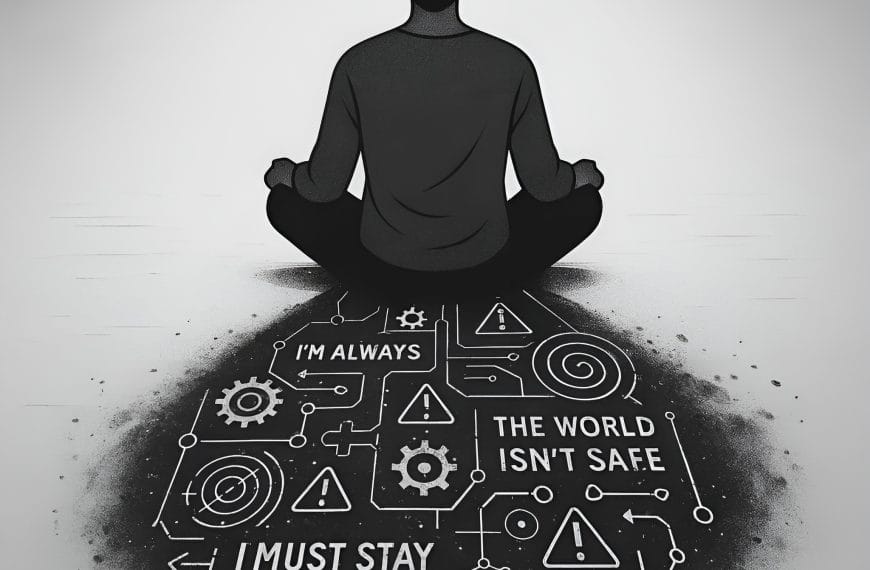
3. Calgary’s Type-A high performers usually share the same identity-level beliefs.
At ShiftGrit, we’ve seen the pattern thousands of times.
Here are the top three identity-level beliefs driving Calgary’s brand of anxiety:
“I Am Not In Control.”
So you over-correct with hyper-control.
Every detail, every timeline, every outcome — managed.
“I Am At Risk.”
So the nervous system stays in perpetual anticipation mode.
You don’t relax. You scan.
“Bad Things Will Happen.”
So you live your life one step ahead of imaginary disasters.
Your brain calls this “being responsible.”
These beliefs run your operating system.
They make you productive.
They also make you miserable.
This is why your anxiety doesn’t feel like anxiety.
It feels like your normal.
4. You don’t break these patterns with coping. You break them with reconditioning.
Let’s talk about the thing no one else tells you:
High performers hate coping strategies.
Breathing exercises?
Nice. But they don’t fix the pattern.
Journaling?
Helpful. But your Walnut Brain doesn’t read English.
Cognitive reframing?
Great — until stress hits, and you default back to your identity loop.
This is why Identity-Level Therapy lands so hard with Calgary’s high performers:
It bypasses the part of your brain that “understands”
and goes after the part that reacts.
Reconditioning does one thing exceptionally well:
It updates the identity pattern so your nervous system stops interpreting:
- slowing down
- letting go
- delegating
- resting
- being imperfect
as threats.
Once the threat signal shuts off?
High performers don’t become lazy.
They become effective without being on fire all the time.
5. The truth no one wants to admit: productivity is often a trauma response with a better LinkedIn profile.
If you’re honest with yourself:
You don’t work this hard because you love the grind.
You work this hard because:
- Your worth feels tied to output
- Being unprepared feels dangerous
- Slowing down feels uncomfortable
- Rest feels like guilt
- Perfection feels like safety
That’s not personality.
That’s conditioning.
And conditioning can be reconditioned.
6. When you fix the identity-level pattern, your entire life stops feeling like a crisis you’re managing.
Here’s what high performers experience after reconditioning:
- They still achieve — but without the internal violence
- They think clearly instead of chaotically
- Productivity becomes focused instead of frantic
- They sleep like actual humans
- Their relationships stop feeling like another job
- The internal “pressure dial” finally turns down
Or as one client said:
“It feels like someone took a weight off my nervous system I didn’t know I was carrying.”
Exactly.
Because for the first time, your brain isn’t trying to survive your life.
It’s actually living it.
If you’re a Type-A Calgarian, your anxiety isn’t random. It’s patterned. And patterns can be rewritten.
This is exactly why Identity-Level Therapy was built:
Not to help you cope with anxiety…
…but to help you eliminate the identity patterns driving it.
If you want the Calgary version of anxiety to stop running your life — without sacrificing your ambition — Identity-Level Therapy is the fastest route out.
Because high performers don’t need coping skills.
They need repatterning.