Not all stress looks like panic.
And not all burnout looks like collapse.
For many men, burnout doesn’t show up in ways that are easily recognized—not even by themselves. It doesn’t always come with tears, anxiety, or emotional overwhelm. Instead, it often arrives as something more subtle—and more dangerous: numbness.
The men who eventually reach out for burnout therapy calgary tend to arrive after the numbness has been the dominant signal for six or twelve months. The numbness isn’t the malfunction. It’s a downstream protective response from a nervous system that has been told for too long to push through. The work isn’t about teaching someone to feel again on command. The work is identifying the limiting beliefs about effort, worth, and what it means to need rest that kept the override running long after the body started flagging it.
The men who eventually come in for depression therapy calgary almost always arrive after a year or two of telling themselves it’s just stress, or just work, or just the season they’re in. A meaningful subset of those presentations also overlap with what trauma therapy calgary tends to address, particularly when the numbness is downstream of a much older event the nervous system never finished metabolising. The surface picture looks like burnout. Underneath, the limiting beliefs about what it means to need help, or to fall short, are doing most of the work.
A sense of disengagement. Irritability. Low motivation. Not caring like you used to. You’re not freaking out. You’re just… checked out.
If that sounds familiar, it’s not laziness. It’s not weakness.
It’s burnout—and it’s running a deeper pattern than most people realize.
Table of Contents
The Hidden Burnout Pattern in Men
At ShiftGrit, we talk a lot about identity-level patterns—the subconscious loops that quietly drive how we react, feel, and function. And in our work with male clients, a particular pattern shows up again and again.
It starts with a limiting belief. These are global identity statements like:
- “I have to be strong.”
- “I can’t show weakness.”
- “If I need help, I’ve failed.”
- “My value comes from what I do.”
These beliefs don’t form out of nowhere. They often trace back to early experiences—whether that’s being told to “man up,” seeing emotional vulnerability punished, or being praised only for productivity and problem-solving.
To avoid the pain of those beliefs, the brain creates a dysfunctional need™. This might sound like:
- “I need to stay in control.”
- “I need to provide.”
- “I need to have it together at all times.”
These needs drive behaviour. And they usually work… for a while.
Feeling stuck in overdrive—or shut down altogether?
If you’re showing up for everyone else but feeling disconnected from yourself, it may be time to address what’s really behind it.
Learn more about our therapy for men in Calgary →
The Cost of Staying in Control
When you’re operating from one of these patterns, you get really good at staying composed, working hard, and holding it all in. You become “the reliable one.” The one who doesn’t flinch. The one who solves problems and keeps moving.
But here’s the catch: that system is burning through your capacity. Every time you push down a feeling, skip a break, or avoid asking for help, you’re filling the pressure cooker.
Eventually, there’s no room left. But instead of exploding, many men just… shut down.
- You stop caring.
- You lose interest in things that used to light you up.
- You feel irritated by everyone, but can’t explain why.
- You find yourself withdrawing, zoning out, drinking more, or looking for numbing behaviours.
You’re not “handling it.” You’re dissociating from it.
And that’s what makes this kind of burnout so insidious—it doesn’t always scream. It whispers.
Feeling disconnected, irritable, or just… numb?
You’re not broken—and you’re not alone.
ShiftGrit’s Identity-Level Therapy helps men retrain the internal system behind burnout, emotional shutdown, and pressure-based performance.
→ It’s not about talking it out. It’s about finally turning it off.
When Numbness Becomes the Norm
If you’ve been in that space for a while, you might not even register it as burnout anymore. You might just call it being tired. Or unmotivated. Or “just how life is.”
But here’s what we’ve learned working with hundreds of clients:
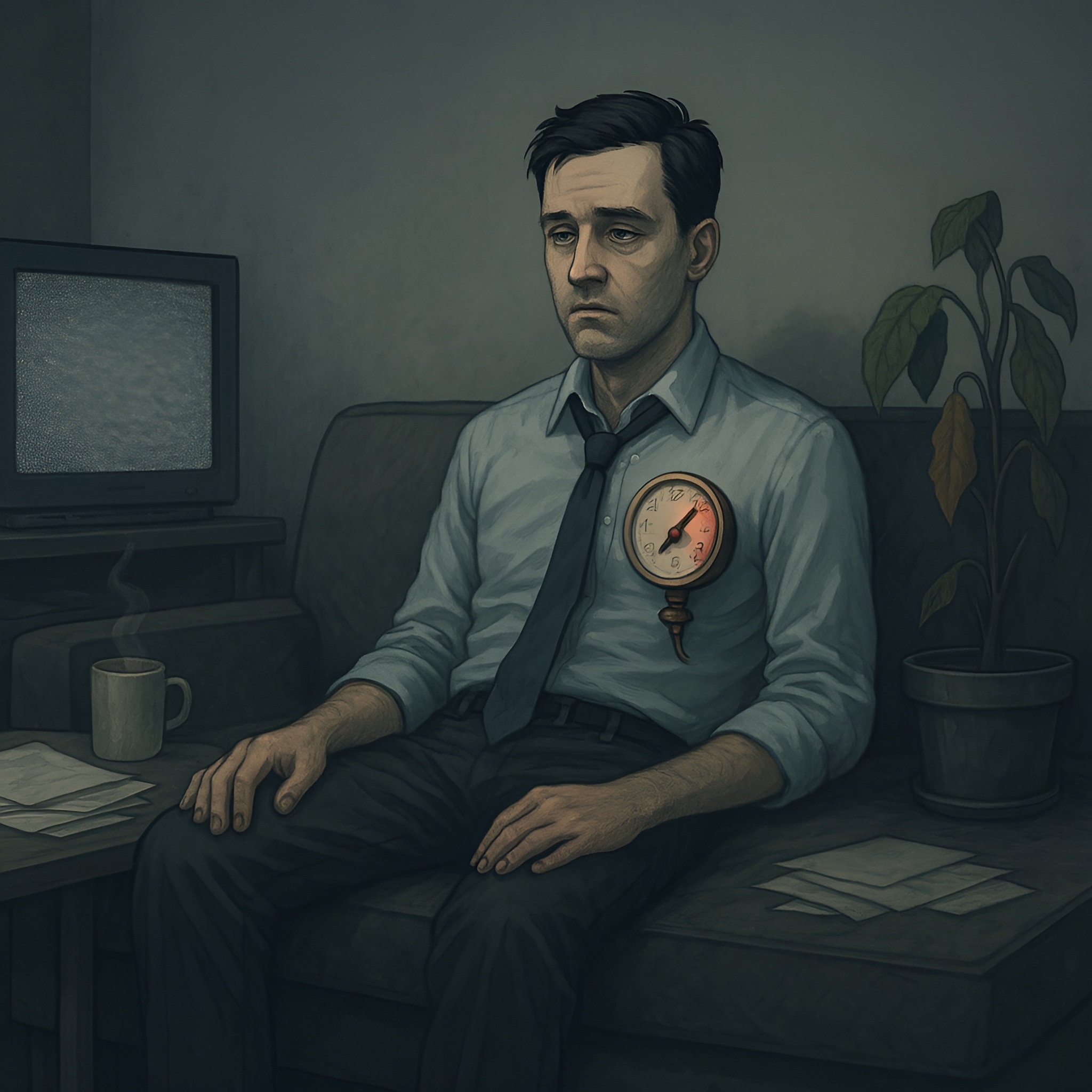
Numbness is not the absence of emotion—it’s a sign that the system is overwhelmed.
Your nervous system has decided it’s safer to shut off than to speak up. That’s not weakness. That’s adaptation. But it’s not sustainable. And it’s not how you’re meant to live.
Note: Research from Vital Mental Health supports that many men experience emotional numbness as a coping mechanism, often due to societal expectations of toughness and resilience.
The Reconditioning Difference
The traditional approach to burnout might tell you to take a break, do more self-care, or talk it out. Those things can help—but when the real issue lives deeper, surface-level solutions won’t move the needle.
That’s why we use a framework called Identity-Level Therapy, grounded in our Pattern Theory™ and Reconditioning Protocol.
We don’t just give you tools to cope with burnout. We help you retrain the internal systems that created it. That includes:
- Identifying the limiting belief behind the pressure
- Mapping the dysfunctional need™ that keeps resetting
- Reconditioning the brain to see that threat as no longer real
When we do this, we don’t just reduce symptoms. We remove the trigger. You don’t have to constantly manage the fire—because it stops relighting.
What Burnout Recovery Can Actually Feel Like
For men who’ve lived in the “always on” mode, recovery isn’t about becoming soft or passive. It’s about becoming free.
- Free to feel without fear
- Free to care about things again
- Free to set boundaries and not carry everyone else’s weight
- Free to live from your values, not just your obligations
Burnout isn’t just about doing too much. It’s about running too long from a belief that was never true in the first place.
You Don’t Have to Shut Down to Be Strong
If you’re noticing the signs—disconnection, irritability, chronic exhaustion—it’s not too late. There’s a system behind it. And there’s a way to change that system.
We’ve helped hundreds of high-functioning men retrain the patterns behind their burnout and return to their lives with clarity, energy, and control that doesn’t cost them everything.
Burnout doesn’t always mean breaking down. For many men, it shows up as emotional shutdown—numbness, disconnection, and irritability. If that sounds familiar, you’re not alone—and you’re not stuck.
Our identity-level therapy approach helps uncover and rewire the patterns driving emotional exhaustion—so you’re not just coping with burnout, you’re dissolving it at the root.
Ready to get your edge back—without burning out to keep it?
Book a free 15 minute call with our Client Experience Specialist here.
Next Step: Your Turn
If you’re in Calgary and reading this thinking, “This is me,” here’s what to do:
- Explore our Burnout Therapy in Calgary page.
- Meet the Calgary Burnout Pattern Therapists who work with burnout daily.
- Wondering about costs? See our Therapy Fees in Calgary guide.
- Are you looking for Burnout Therapy in Edmonton instead?
Burnout doesn’t have to be your baseline. The first step is seeing the pattern. From there, you can change the whole cycle.
The numbness pattern is the late stage of unaddressed stress, particularly for men who have been told for decades that emotional regulation is something other people do. The stress signal kept firing, the system kept producing, and eventually the body just turned the volume down on everything to keep functioning. By the time someone reaches out for stress therapy calgary, the numbness is often what brought them in, not the stress itself. The work goes after the underlying belief, often something close to “It’s My Fault” or “I Am Responsible,” that made shutdown the only available option.
When emotional numbness is the dominant tell, what looks like burnout from the outside often reads clinically as depression. The system has stopped registering signal, including the signals that would otherwise produce hope, connection, or motivation. Edmonton depression counselling clients running this pattern often arrive after years of being told to “just push through” by environments that needed the output more than the person. The belief layer underneath the numbness is where the actual work lives, and that is what the ShiftGrit Core Method™ addresses.
Find the pattern behind what's been feeling hard
A few simple questions to help surface the concerns that may fit best.
Find Your Pattern
