
Burnout rarely arrives as a sudden collapse. It builds quietly: the moves that get you through a hard week, such as pushing harder, going quiet, or checking everything twice, are the same moves that deepen it. Most advice treats the symptoms while that loop keeps running. For working adults in Calgary, the World Health Organization frames burnout as an occupational phenomenon that results from chronic workplace stress that has not been successfully managed: a triad of emotional exhaustion, increased mental distance or cynicism, and reduced professional efficacy. It is not classified as a medical condition in the ICD-11.
This article focuses on what keeps the exhaustion cycle stuck and where meaningful change is possible. We ground the explanation in authoritative sources, including the WHO definition and guidelines, systematic reviews on individual and organizational interventions, and the Canadian Psychological Health and Safety Standard. We also offer a ShiftGrit conceptual lens to help map identity-driven patterns that may maintain the loop: framed as a way to think about the problem, not as proof of a unique treatment.
If you are seeking burnout therapy in Calgary, this overview aims to set realistic expectations: individual therapy can help, workplace changes often matter, and progress is usually incremental and monitored over time.
Table of Contents
Key Highlights
- Burnout is an occupational syndrome marked by exhaustion, cynicism, and reduced professional efficacy; it is not a medical diagnosis in ICD-11.
- The cycle often persists when mismatches between job conditions and person factors (workload, control, reward, community, fairness, values) remain unresolved.
- CBT- and mindfulness-based individual interventions can reduce aspects of burnout, particularly exhaustion, with average effects that are modest and variable across settings.
- Benefits from individual therapies usually show up in the short term, and holding those gains takes ongoing practice plus, where possible, workplace adjustments.
- Organizational interventions (e.g., workload management, role clarity, supportive supervision) can reduce exhaustion; combined approaches may be more comprehensive.
- In Canada, the National Standard (CSA Z1003) offers a practical framework for addressing psychosocial risks; therapy can help prepare and pace requests for change.
- From a ShiftGrit lens, identity-level beliefs may shape protective overwork or withdrawal; this is a conceptual map to guide behaviour experiments, not a proof of superiority.
Patterns can make burnout easier to spot in everyday life. Rather than focusing only on labels, look for how energy, attitudes, and performance shift in predictable ways under persistent job strain.
- Energy does not recover after time off; weekdays begin with a sense of being already depleted (emotional exhaustion).
- Attitudes shift from caring to detached or cynical toward tasks, colleagues, or clients (increased mental distance/depersonalization).
- Self-doubt and reduced sense of competence rise, with more errors, rework, or procrastination on complex tasks (reduced professional efficacy).
- Work spills into evenings and weekends to catch up, cutting into recovery time and reinforcing fatigue.
- Conversations and feedback are avoided because they feel effortful; humour or sarcasm functions as protective distance.
A common escalation looks like this: heavy workload or low control leads to rushing and overextension, which increases mistakes or missed deadlines, which then fuels self-doubt or cynicism and prompts further withdrawal or compensatory overwork. Over time, this loop consolidates unless the stressors are reduced or coping patterns change.
What burnout is, and why the exhaustion cycle persists
ICD-11 defines burnout as a syndrome resulting from chronic workplace stress that has not been successfully managed. It features three components: exhaustion, increased mental distance or cynicism, and reduced professional efficacy, and is explicitly positioned within the occupational context rather than as a medical diagnosis. This placement guides assessment toward job-related contributors and functioning, rather than a disease label.
Research describes emotional exhaustion as the central component. Under sustained overload, people often adopt short-term protective strategies, such as detachment or depersonalization, to conserve energy. While understandable, this distancing can erode motivation and a sense of impact, leading to reduced efficacy over time. Recognizing this sequence helps normalize why someone might toggle between pushing harder and pulling away, both are attempts to cope with continuous strain.
Why does the cycle persist? One key model highlights mismatches between the person and six areas of work life:
- Workload: Chronic high demand leaves insufficient time for recovery (e.g., compressed deadlines that repeatedly require after-hours effort).
- Control: Low decision latitude or shifting priorities reduce a sense of agency (e.g., frequent changes in task order with little input).
- Reward: Limited recognition or progress signals diminish motivation (e.g., efforts rarely acknowledged beyond “meeting minimum expectations”).
- Community: Strained team dynamics or isolation remove social buffers (e.g., conflictual handovers or lone working).
- Fairness: Unequal workload distribution or unclear processes raise perceived injustice.
- Values: Role expectations clash with personal or professional values (e.g., pressure to prioritize speed over quality).
International guidance and Canadian standards identify these psychosocial risks as legitimate targets for prevention and mitigation. Managing hazards such as excessive workload, low role clarity, or poor support can reduce baseline strain, making individual coping strategies more effective.
Because burnout is dimensional, structured tools aligned with the triad (such as measures addressing exhaustion, cynicism, and efficacy) can help track change. Monitoring which component is shifting, e.g., exhaustion drops while cynicism remains, can inform next steps.
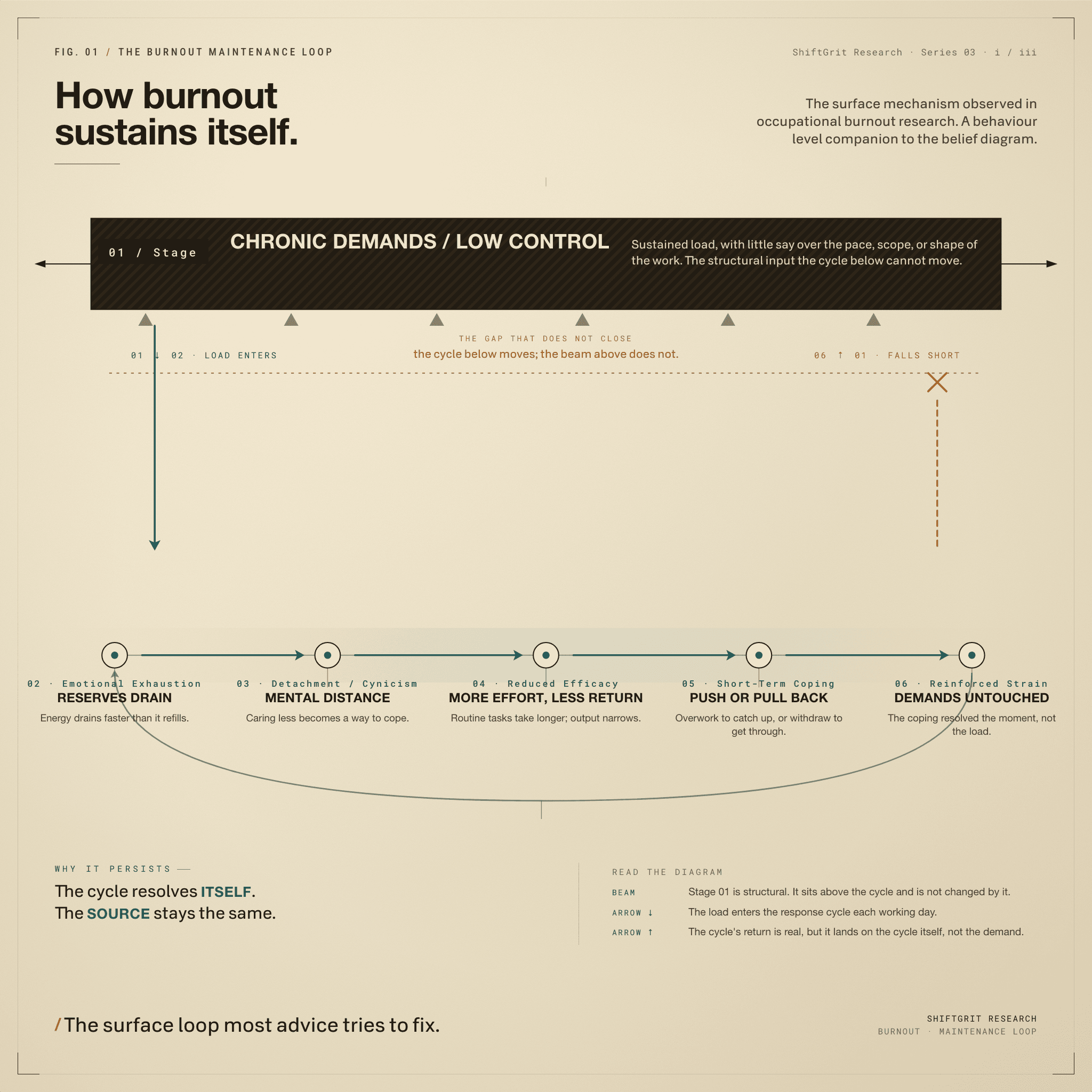
Figure 1. The burnout maintenance loop: the surface mechanism of occupational burnout. Sources: World Health Organization, ICD-11 (2019); Maslach and Leiter, World Psychiatry (2016), doi.org/10.1002/wps.20311.
What individual-level therapies can change, and what their limits are
Systematic reviews, including a recent Cochrane review and an RCT-only meta-analysis, suggest that individual-level psychosocial interventions can reduce aspects of burnout, particularly emotional exhaustion, among workers, most consistently studied in healthcare settings. Average effects are typically modest and vary by program and context. This means improvements are often noticeable but incremental, and expectations should be set accordingly. In one of the largest reviews to date, a 2026 Annals of Internal Medicine meta-analysis of 99 randomized trials (9,330 participants) found that, among physicians, professional coaching probably reduced emotional exhaustion, a small effect (a standardized mean difference of about 0.37, low certainty). The effect is real but modest, not transformative, which is why it works best alongside changes to the work itself.
Guidelines recommend CBT-based stress management and mindfulness-based approaches as options for workers experiencing stress and burnout-related symptoms. CBT tends to focus on reshaping unhelpful appraisals and recalibrating behaviour (for example, breaking overwork-avoidance cycles), while mindfulness training strengthens attentional flexibility and non-reactivity, helping reduce cognitive load and rumination. These mechanisms can translate into less perceived demand and more recovery opportunities in day-to-day work.
A consistent finding across reviews is that benefits are generally assessed at short-term follow-up, and longer-term durability is less certain. Skills may fade without reinforcement, and if workplace stressors persist unchanged, they can reassert their influence. Planning for maintenance, brief practices, booster sessions, and aligning therapy gains with feasible workplace adjustments, can help sustain progress.
For employees with clinical-level burnout presentations, reviews indicate that individually oriented and combined interventions can reduce symptoms. Evidence for return-to-work outcomes is mixed, reflecting how much ongoing workplace factors influence sustainability. Collaborative planning that includes pacing and role clarity discussions may support more stable re-engagement when feasible.
The table below summarizes common individual interventions, their targets, and key evidence notes.
Common Individual Interventions for Burnout-Related Distress: Targets and Evidence Notes
| Intervention | Primary targets | Typical delivery | Evidence notes | Key cautions |
|---|---|---|---|---|
| CBT-based stress management | Appraisal (catastrophizing, all-or-nothing), behavioural routines (overwork/avoidance) | Individual or group sessions; skills practice between sessions | Supported by guidelines and reviews for small average reductions in exhaustion among workers, especially in healthcare | Addresses coping; does not alter workplace hazards by itself; long-term durability uncertain |
| Mindfulness-based training | Attention regulation (rumination), stress reactivity, present-focused awareness | Group-based curricula; brief daily practices | Systematic reviews note modest, variable benefits for exhaustion and stress | Benefits may wane without continued practice; not a replacement for organizational change |
| Combined individual + work-directed supports | Symptoms plus sources (e.g., role clarity, manager support) | Therapy alongside negotiated workplace adjustments | Conceptually complementary; evidence indicates broader benefits in some contexts | Feasibility depends on workplace capacity; effects vary by implementation quality |
High-level synthesis without effect sizes; characterizes scope and limits based on reviews and guidelines.
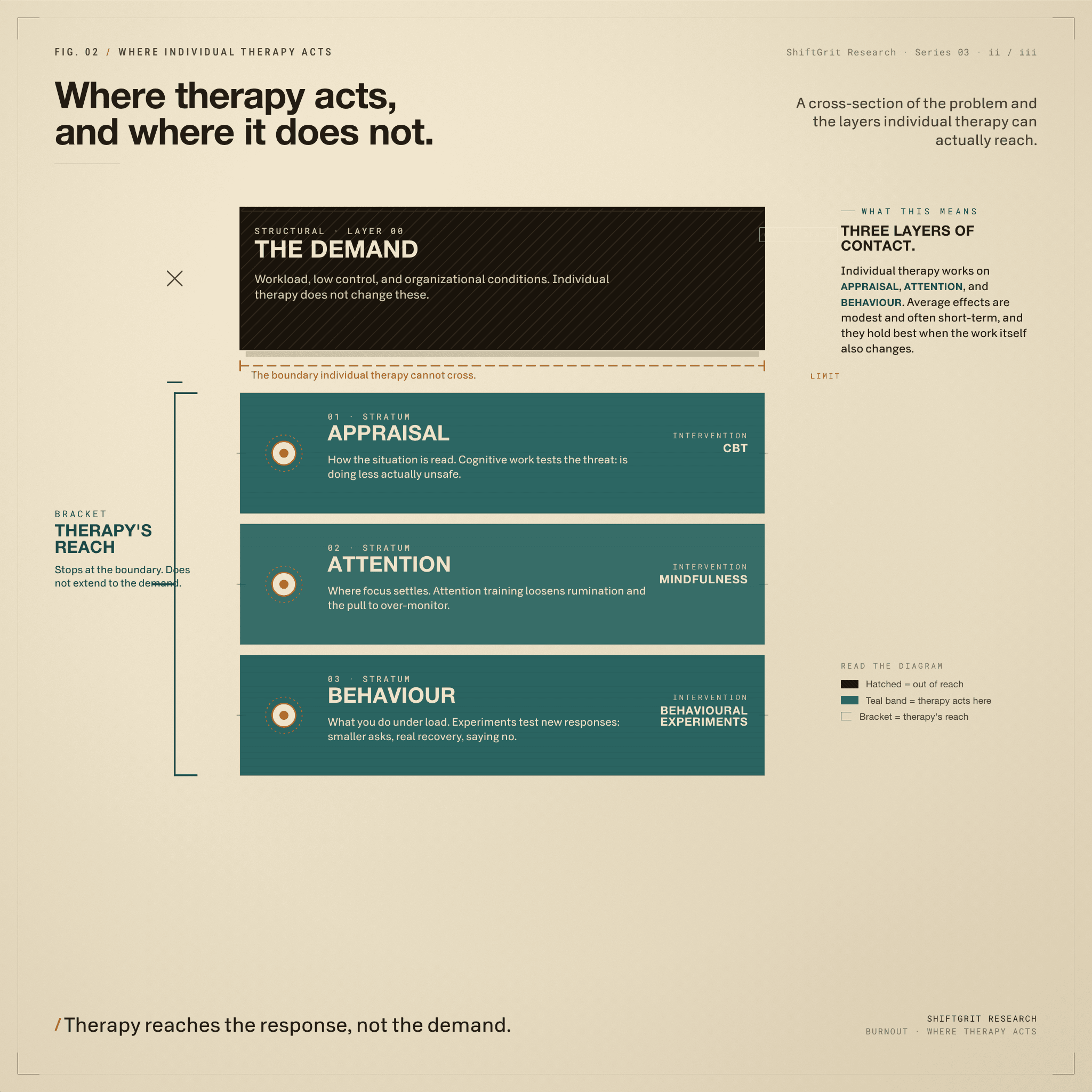
Figure 2. Where individual therapy acts: appraisal, attention, and coping, with effects that are typically modest and short-term. Sources: Tamminga et al., Cochrane Database of Systematic Reviews (2023), doi.org/10.1002/14651858.CD002892.pub6; Collett et al., Annals of Internal Medicine (2026), doi.org/10.7326/ANNALS-25-00469.
Why workplace change matters: organizational and combined approaches
Organizational interventions, those that modify aspects of work itself, can reduce the exhaustion component of burnout. Meta-analytic evidence indicates measurable, though often modest, benefits when workplaces address factors such as staffing, schedules, workload distribution, and role clarity. These findings align with the practical emphasis of international guidelines, which recommend manager training, clear roles, and systematic psychosocial risk reduction.
Mechanistically, when demands are right-sized, decision latitude increases, and support improves, the primary drivers of exhaustion are eased. People then need fewer high-cost coping strategies (such as chronic overwork or withdrawal), and the loop is less likely to self-reinforce. Examples include adjusting ratios or caseloads, clarifying decision boundaries, improving handover processes, and building supportive supervision practices.
In Canada, the National Standard on Psychological Health and Safety provides a staged, hazard-management approach applicable across sectors. It outlines processes for identifying, assessing, and controlling psychosocial risks such as workload, recognition, civility, and fairness. For Calgary employers and employees alike, this offers a shared language for constructive dialogue.
Combined approaches, individual skills plus targeted work-directed changes, may offer broader or more durable relief in some contexts because they address both symptoms and sources. The extent of benefit depends on the fit and fidelity of changes, organizational capacity, and sector-specific realities. Clinically, it is reasonable to explore both lanes where safe and feasible, without assuming that one level alone will resolve the pattern.
Therapy for burnout-related distress often targets the mechanisms that keep the loop going. Evidence-informed approaches focus on three interlocking areas:
- Appraisal: CBT-based methods help identify and reframe threat-heavy interpretations (for example, “If I do not fix everything, failure is certain”) into more workable appraisals. This can lower perceived demand and reduce urgency-driven overwork.
- Attention: Mindfulness training builds the capacity to notice and redirect ruminative focus, which can otherwise drain energy and bias decision-making toward short-term relief (such as avoidance).
- Behaviour: Behavioural experiments test calibrated alternatives to all-or-nothing coping, e.g., time-boxing, limits on rechecking, or graded boundary-setting, so recovery time increases without abandoning core responsibilities.
Across these targets, monitoring is important. Dimensional tracking of exhaustion, cynicism, and efficacy supports timely adjustments. Maintenance plans (brief routines, relapse-prevention cues, scheduled reviews) acknowledge that benefits in trials are commonly short term and that workplace stressors may persist. Therapy can coordinate with feasible workplace adjustments, but it does not replace organizational action when psychosocial hazards remain high.
In the Canadian context, the National Standard on Psychological Health and Safety (CSA Z1003) provides a structured, voluntary framework for managing psychosocial risks linked to burnout. It highlights processes to identify, assess, and control hazards such as excessive workload, limited control, inadequate recognition, and strained community or civility. Employers across sectors in Calgary, public, private, and non-profit, can use the Standard to guide prevention and mitigation, independent of any specific clinical pathway.
For individuals, the Standard offers language to frame reasonable workplace conversations: clarifying roles, calibrating demand to capacity, and improving support and fairness processes. When aligned with therapy goals, such as boundary scripts, pacing plans, or requests for clearer decision latitude, these conversations may help translate personal skills into sustainable change. Adoption and implementation vary by organization, so expectations should be graded.
Where ShiftGrit works: the belief the loop is protecting
Most burnout advice stops at the behaviour: rest more, set boundaries, manage your time. Useful, and rarely enough. The maintenance loop above describes what burnout does on the surface. Underneath it runs a second loop, one level deeper, that explains why the surface loop is so hard to break.
Here is the pattern we look for. It starts with a limiting belief (“I Am Responsible,” “I Am Not in Control,” “It’s My Fault”). Under sustained job strain that belief stops being a background thought and becomes existential tension: doing less feels genuinely unsafe, not just uncomfortable. From there, attention does its own work, organizing evidence that the belief was right, so every close call confirms the worry. The strain of holding all this is pressure that accumulates: capacity narrows and recovery shrinks, the exhaustion of burnout. The release valve is an opt-out, a relief behaviour like overwork, over-checking, or withdrawal that discharges the pressure for an afternoon. But the opt-out leaves the belief untouched, so it is confirmed and the loop tightens. The symptom is how the loop announces itself. The belief is what the loop exists to protect.
That belief is not irrational. It was adaptive once. The work is not to argue with it. It is to change what you have to do to feel safe.
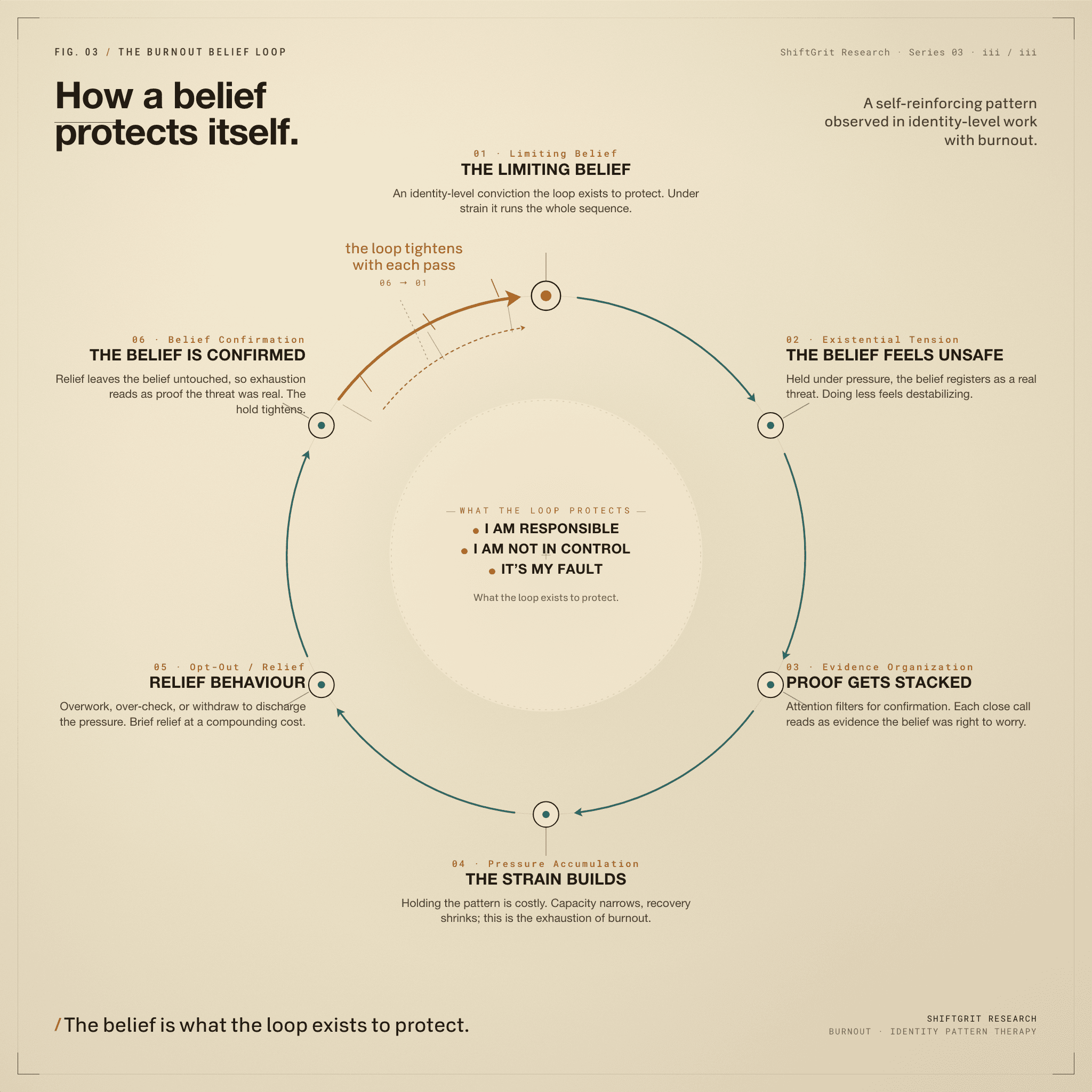
Figure 3. The burnout belief loop: ShiftGrit’s identity-pattern model of how a limiting belief sustains burnout. identity-pattern therapy.
Consider Daniel, a composite of the Calgary professionals we see, who holds “I Am Responsible”. On paper it is a strength: Daniel catches what others miss. Under a heavy quarter it becomes a trap. Every request feels like his to carry, saying no feels like dropping the ball, so he absorbs more, works later, recovers less. The late nights buy a day of relief and cost a month of energy. By the time Daniel looks for help, it reads as “poor time management”. It is not. It is a belief doing exactly what it was built to do, in a situation that no longer rewards it.
The three beliefs we see most in burnout
- “I Am Responsible” turns every demand into a personal duty, so you overcommit and cannot say no. The leverage point is not “say no more”. It is loosening the belief until one deferred, low-stakes request stops feeling like failure.
- “I Am Not in Control” makes uncertainty feel dangerous, so urgency and over-checking climb to manage it. The leverage point is restoring one real, specific piece of agency, which lowers the felt need to control everything.
- “It’s My Fault” drives perfectionistic checking and self-criticism that stretch your hours and drain the reward out of the work. The leverage point is changing the standard the belief enforces, not white-knuckling through it.
That is the difference. Time-management tips work on the behaviour. ShiftGrit works on the belief the behaviour is protecting, so the behaviour has less to defend.
A note on the workplace: this inner work changes how you carry the load, not the size of the load. Where a job’s demands are genuinely unsustainable, the most durable progress pairs belief work with real changes at work, and we plan for both.
Identity-Level Therapy
Identity-Level Therapy targets the belief patterns and emotional loops driving automatic reactions—not just the surface symptoms. By working at the identity layer, clients shift how they interpret safety, regulate threat, and relate to themselves and others. The result: reconditioning at the root of shame, self-sabotage, reactivity, and overwhelm.
It’s organized around three pillars:
ShiftGrit Core Method™
Our structured framework for breaking outdated identity patterns.
Learn more about ShiftGrit Core Method™
The Pattern Library
Real-world examples of loops like perfectionism, procrastination, and shutdown.
Learn more about The Pattern Library
The Glossary
Clear definitions that keep the language sharp and the process transparent.
Learn more about The GlossaryBurnout therapy in Calgary sits within a broader reality: burnout is an occupational phenomenon driven by chronic work stressors, with emotional exhaustion at its core. Evidence suggests that individual psychosocial interventions can reduce aspects of burnout, particularly exhaustion, with average effects that are modest and commonly short term. Organizational interventions can also reduce exhaustion, and in some contexts, combining personal skills with targeted workplace changes may offer broader relief.
Practical next steps include mapping your own loop, identifying the most salient job-person mismatches, setting a few mechanism-aligned therapy targets, and, where feasible, engaging in constructive, guideline-informed workplace conversations. Dimensional monitoring of exhaustion, cynicism, and efficacy helps calibrate the plan. From a ShiftGrit perspective, linking identity-level beliefs to micro-tests can create sustainable room for recovery while respecting safety and responsibility.
Progress is typically incremental. With careful goal-setting, collaboration, and consistent review, the exhaustion cycle can be loosened, even when not every stressor is immediately changeable.
Frequently asked questions
If burnout is wearing down your work and wellbeing, you can get matched with a ShiftGrit therapist in Calgary.
What exactly is burnout, and is it a medical diagnosis?
Burnout is described by the World Health Organization as an occupational phenomenon resulting from chronic workplace stress that has not been successfully managed. It presents as emotional exhaustion, increased mental distance or cynicism, and reduced professional efficacy. It is not classified as a medical diagnosis in ICD-11. Assessment and support typically focus on job-related stressors and functioning.
Does therapy help burnout, and what changes should I expect?
Research syntheses indicate that individual psychosocial interventions, such as CBT- and mindfulness-based approaches, can reduce aspects of burnout, particularly emotional exhaustion. Average improvements are modest and vary by program and setting, with benefits most often shown in the short term. Therapy targets appraisals, attention, and coping behaviours to increase recovery time. Lasting progress may be strengthened by workplace adjustments when feasible.
What workplace changes can reduce burnout risk or support recovery?
International guidelines recommend measures such as workload management, role clarity, supportive supervision, and psychosocial risk reduction. A Canadian standard (CSA Z1003) offers a staged framework for identifying and controlling hazards like high demands, low control, and poor community or civility. These actions can reduce baseline strain and help interrupt the exhaustion cycle. Effects vary by context and implementation quality.
How long does it take to feel better from burnout with therapy?
Trials commonly assess outcomes at short-term follow-up, so improvements may emerge over weeks to a few months, though timelines vary. Benefits are typically modest and depend on context, engagement, and whether job stressors remain high. Maintenance practices and scheduled reviews can help sustain gains. Where feasible, pairing therapy with workplace adjustments may support more durable change.
How is progress monitored during burnout therapy?
Because burnout is dimensional, tracking the core components: exhaustion, cynicism, and professional efficacy, can guide care. Validated measures aligned with this triad are often used to monitor change and tailor interventions. Monitoring clarifies whether specific targets, like exhaustion, are improving while others need attention. These tools inform planning but do not function as a medical diagnosis.
Sources for the article
World Health Organization. Burn-out an 'occupational phenomenon': International Classification of Diseases (ICD-11) FAQ. World Health Organization. 2019.
Maslach C; Leiter MP. Understanding the burnout experience: recent research and its implications for psychiatry. World Psychiatry. 2016. DOI: 10.1002/wps.20311
World Health Organization. WHO guidelines on mental health at work. World Health Organization (NCBI Bookshelf). 2022.
Tamminga SJ; Emal LM; Boschman JS; Levasseur A; Thota A; Ruotsalainen JH; Schelvis RMC; Nieuwenhuijsen K; van der Molen HF. Individual-level interventions for reducing occupational stress in healthcare workers. Cochrane Database of Systematic Reviews. 2023. DOI: 10.1002/14651858.CD002892.pub6
Bes I; Shoman Y; Al-Gobari M; Rousson V; Guseva Canu I. Organizational interventions and occupational burnout: a meta-analysis with focus on exhaustion. International Archives of Occupational and Environmental Health. 2023. DOI: 10.1007/s00420-023-02009-z
Ahola K; Toppinen-Tanner S; Seppänen J. Interventions to alleviate burnout symptoms and to support return to work among employees with burnout: Systematic review and meta-analysis. Burnout Research. 2017. DOI: 10.1016/j.burn.2017.02.001
Psychological health and safety in the workplace, Prevention, promotion, and guidance to staged implementation (CAN/CSA-Z1003-13/BNQ 9700-803/2013 (R2022)). CSA Group / BNQ (National Standard of Canada). 2022.
Collett G; Gupta J; Eltayeb A; Korszun A; Sharples L; Rice K; Gupta AK. Efficacy of Individual-Level Interventions to Mitigate the Risk for Burnout Among Health Care Professionals: A Systematic Review and Meta-analysis of Randomized Controlled Trials. Annals of Internal Medicine. 2026. DOI: 10.7326/ANNALS-25-00469

